
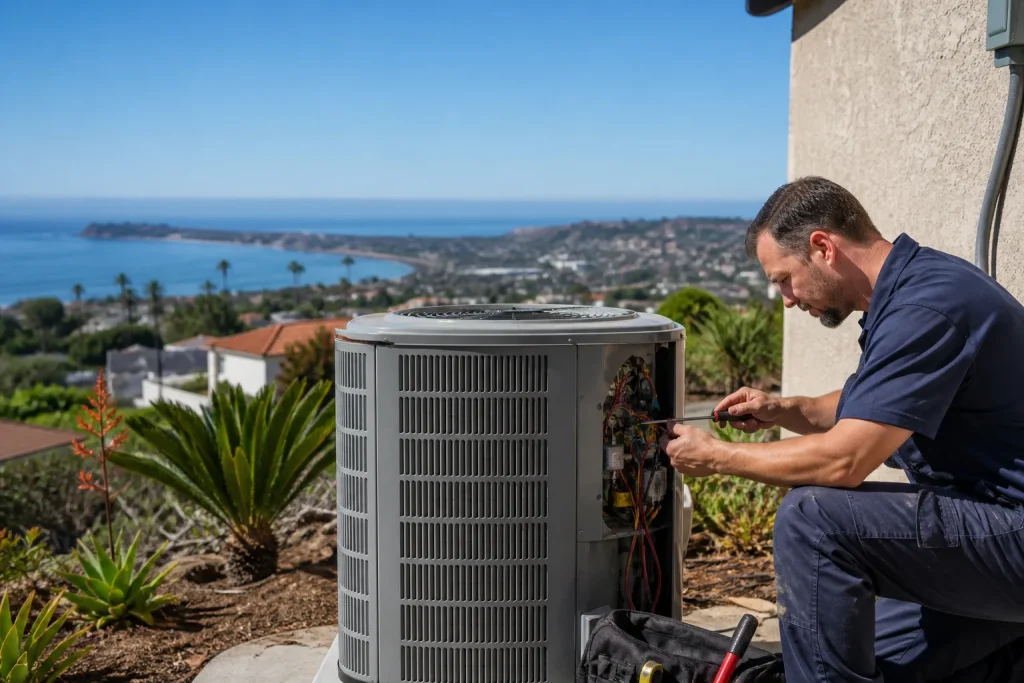
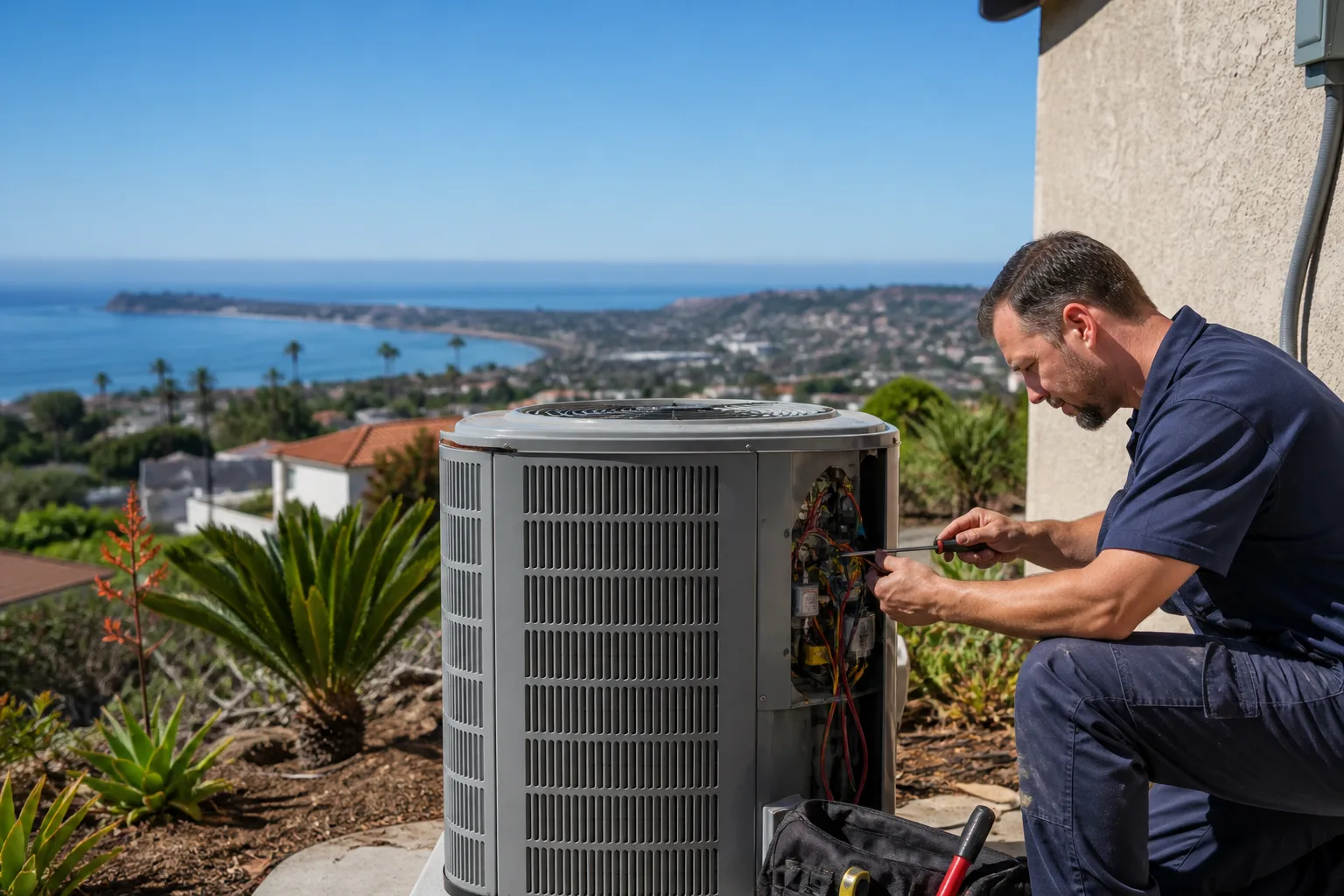
Lennox AC Repair & Installation in San Diego: A Homeowner’s Guide
Lennox AC repair in San Diego typically costs $180–$650 for common issues, while a full Lennox installation runs $5,500–$12,000 depending on the series and home size. The brand’s high-efficiency variable-speed systems deliver excellent SEER ratings, but their iComfort communicating technology and coastal corrosion vulnerabilities require technicians who understand Lennox-specific diagnostics. If you’re troubleshooting a Lennox system right now and want a Master Technician to look at it, call us at (844) 875-9451 — estimates are free.
Last month we were out in La Jolla where a homeowner had already paid another company $380 to replace a “failed” control board on their XC25. The real problem? A communication dropout between the iComfort thermostat and the variable-speed air handler. A 10-minute firmware re-pair solved it. That’s the pattern we see with Lennox in San Diego — genuinely sophisticated equipment that gets expensive when technicians treat it like a generic system.
Which Lennox Systems Are Most Common in San Diego Homes
Through 13 years of running Redwood Heating & Air San Diego, we’ve worked on every major Lennox residential line installed in the county. The units we encounter most often in San Diego’s coastal and inland neighborhoods fall into three categories:
- XC21 and XC25 series — Variable-capacity condensers popular in newer builds from Del Mar to Rancho Bernardo. The XC25 hits 26 SEER but requires precise static pressure setup to deliver that efficiency in practice.
- EL16XC1 and EL18XCV — Single-stage and two-stage workhorses found in thousands of 1990s–2010s tract homes across Mira Mesa, Clairemont, and Chula Vista.
- iComfort-enabled systems — Communicating thermostats paired with SL280V furnaces or CBX40U air handlers. These are where we see the most misdiagnosis by non-Lennox-trained technicians.
Each line has distinct maintenance intervals. The XC25’s inverter-driven compressor needs annual coil cleaning and refrigerant verification — more frequently if you’re within two miles of the coast. We’ve found that skipping this in Ocean Beach or Pacific Beach leads to premature bearing wear, typically around year 6–8 instead of the 12–15 year design life.
The EL16XC1 is more forgiving but still vulnerable to the corrosion issue we’ll cover below. In our experience across San Diego’s microclimates, inland units in Poway or Santee last 2–3 years longer than identical models installed in Point Loma or Coronado.
The iComfort Communication Problem That Costs Homeowners Hundreds
Here’s the technical issue competitors rarely explain clearly. Lennox’s iComfort system uses a proprietary serial communication protocol between the thermostat, furnace or air handler, and outdoor condenser. When this communication chain breaks, the thermostat displays a “Communication Fault” or simply goes blank.
Non-Lennox-trained technicians see this and replace the control board — it’s the obvious move on a Carrier or Trane. But on Lennox, the fault often traces to:
- Low-voltage wiring polarity reversal during a previous service call — the iComfort S30 is polarity-sensitive where most stats aren’t.
- Software pairing loss after a power outage, especially common in San Diego’s older neighborhoods with aging grid infrastructure.
- Failed indoor air quality sensor (temperature or humidity) that causes the communicating network to shut down protectively.
We carry the iComfort service software on our tablets. In about 30% of “communication fault” calls we run in San Diego, no hardware replacement is needed at all. That’s $0–$150 versus $350–$600 for a board swap.
This is where our multi-brand fluency matters. A technician who only knows Carrier or Trane wiring conventions will troubleshoot by habit, not by Lennox specification. Gregory Hahn founded this company and still leads every technical decision — when a Lennox system comes in, we’re diagnosing against Lennox’s protocol, not assuming it behaves like the nine other brands we service.
Coastal Corrosion: The San Diego-Specific Lennox Killer
This is the information gain section that separates useful content from generic filler. San Diego’s marine layer carries salt and organic acids that attack copper evaporator coils through a mechanism called formicary corrosion — tiny pinhole leaks that develop from the inside out, invisible until refrigerant loss becomes critical.
Lennox uses copper tube-and-fin coils in most residential lines. They’re well-made coils, but copper is copper. We’ve replaced more Lennox evaporators in coastal San Diego ZIP codes than anywhere else we work, and the pattern is unmistakable:
- Homes within 1 mile of the coast: coil failures at 5–8 years common
- Homes 1–3 miles inland (Mission Valley, Linda Vista): 8–11 years typical
- Inland valleys (Rancho Peñasquitos, 4S Ranch): 12–15 years, matching design spec
The diagnostic challenge? Formicary leaks are microscopic. A standard electronic leak detector won’t find them. We use pressurized nitrogen with trace dye, then ultraviolet inspection — a procedure many rush-repair outfits skip because it adds 45 minutes to the call.
Prevention is limited but real. Annual maintenance with foaming cleaner (not just water rinse) removes the salt film that accelerates corrosion. For new installations in coastal zones, we spec coated coils or aluminum alternatives where the application allows. The efficiency hit is 2–3%, but the lifespan extension in San Diego’s coastal climate pays for itself.
Lennox Warranty Reality: OEM Parts vs. Aftermarket
Lennox factory warranties — 10 years on compressors in most current lines, 5 years on parts for registered equipment — require OEM or Lennox-authorized replacement components. Use a generic capacitor or aftermarket board, and you’ve voided coverage on the entire system.
We’ve seen this sting homeowners twice. First, when a budget repair shop installs a $12 universal capacitor instead of the Lennox-specified dual-run with correct microfarad tolerance. The compressor fails six months later, and Lennox denies the claim because the electrical history shows non-OEM parts. Second repair costs $2,800 instead of the $180 it should have been.
At AC Repair & Installation in San Diego, we stock Lennox OEM components for the lines we service most. If we’re repairing your XC21 or EL18XCV, the part carries full factory warranty support. We also document serial numbers and installation photos for warranty registration — a step that’s easy to skip and expensive to need later.
For systems out of warranty, we still discuss OEM versus quality aftermarket options honestly. Sometimes the aftermarket part makes sense. Sometimes it doesn’t. The decision depends on how long you plan to keep the system and what other components are showing wear.
Installation: Why Lennox Variable-Speed Systems Need Proper Setup
A Lennox XC25 or XC21 installed without correct static pressure measurement and airflow balancing will not achieve its rated SEER. Period. We’ve tested “new” installations in San Diego where the actual efficiency was 15–20% below spec because the ductwork couldn’t move the air the variable-speed system was designed to push.
The specific requirements:
- Static pressure testing at commissioning — total external static pressure must fall within Lennox’s published range for the air handler model, typically 0.3–0.7 inches water column.
- Air handler dip switch configuration for the correct tonnage and airflow profile. The CBX32MV and similar units ship in default mode; they don’t self-configure.
- Thermostat commissioning sequence for iComfort systems — the S30 runs a 15-minute self-test that many installers skip.
We see shortcut installations most often from builders’ contractors working on tight schedules in new developments. Last year we re-commissioned three systems in a Carmel Valley tract where the original installer had left all air handlers at factory default. The homeowners’ summer bills dropped 18–22% after proper setup.
If you’re considering a new Lennox installation in San Diego, ask your contractor specifically about static pressure testing and commissioning documentation. If they hesitate or change the subject, that’s information.
When to Call a Pro for Lennox AC Issues
Some symptoms mean stop troubleshooting and get a technician:
- Any burning electrical smell from the indoor unit or outdoor condenser
- Refrigerant hissing or oil staining near line sets — indicates a leak that requires EPA-certified handling
- Complete system deadness after a storm — possible compressor electrical damage
- iComfort thermostat showing “System Malfunction” with any error code starting in 4xx or 5xx
We’re available for emergency HVAC service when these situations hit. For non-urgent concerns — rising bills, uneven cooling, unusual cycling — our regular diagnostic calls include full system analysis, not just a quick refrigerant top-off.
Related services in San Diego: Heating & Furnace in San Diego | Heat Pump & Mini Split in San Diego
The Bottom Line
Lennox makes excellent equipment, but its sophistication demands technicians who know the brand’s specific behavior. In San Diego, that means understanding iComfort communication protocols, recognizing coastal formicary corrosion before it becomes a leak, and installing variable-speed systems with the commissioning rigor they require. Generic HVAC knowledge isn’t enough — we’ve seen it cost homeowners unnecessary parts and missed warranty coverage.
Key takeaways for San Diego Lennox owners:
- Annual maintenance is non-negotiable within 3 miles of the coast
- “Communication Fault” on iComfort rarely means board failure — get a second opinion from a Lennox-experienced technician
- Insist on OEM parts while under warranty; document everything
- New variable-speed installations require static pressure testing and proper commissioning
- 13 years, 428+ reviews: longevity with accountability matters when you’re trusting someone with a $10,000 system
If you’re in San Diego and need help with your Lennox system — whether it’s a mystery fault code, a suspected leak, or you’re weighing repair versus replacement — Redwood Heating & Air San Diego offers free estimates. Call (844) 875-9451 and ask for Gregory. We’ll diagnose it right the first time.
Frequently Asked Questions
Most Lennox repairs in San Diego fall between $180 and $650. Simple fixes like capacitor replacement or iComfort re-pairing run $180–$280. Compressor or coil work ranges $400–$1,200 depending on the part and whether your system is under warranty. We provide exact quotes after diagnosis — estimates are free, so call (844) 875-9451.
Replace if your Lennox system is over 12 years old and the repair exceeds $1,500, or if it uses R-22 refrigerant (phased out, increasingly expensive). Repair if it’s under 10 years, well-maintained, and the fix is under $800. In San Diego’s coastal zones, factor in whether corrosion has already damaged multiple components. We assess this honestly on every call — call (844) 875-9451 for a free evaluation.
The iComfort thermostat loses communication with the furnace, air handler, or outdoor unit. Causes include power outage pairing loss, low-voltage wiring issues, or a protective shutdown from a failed sensor. About 30% of these require no parts — just software re-pairing or wiring correction. Many technicians misdiagnose this as a failed control board. If you’re seeing this code in San Diego, we can walk you through basic resets or come diagnose it properly.
12–15 years with proper maintenance in inland San Diego areas like Poway or Santee. Coastal installations in La Jolla, Ocean Beach, or Coronado often see 8–12 years due to salt-air corrosion of copper coils. Annual maintenance with foaming cleaner extends lifespan measurably. We’ve maintained Lennox systems in San Diego that reached 18 years, and we’ve seen neglected coastal units fail at 6. The variable is care, not just build quality.
Written by Gregory Hahn, Founder & Master Technician at Redwood Heating & Air San Diego, serving San Diego since 2013.
Need HVAC Help?
Call Redwood Heating & Air San Diego — licensed & insured, available 24/7 in San Diego.
(844) 875-9451