
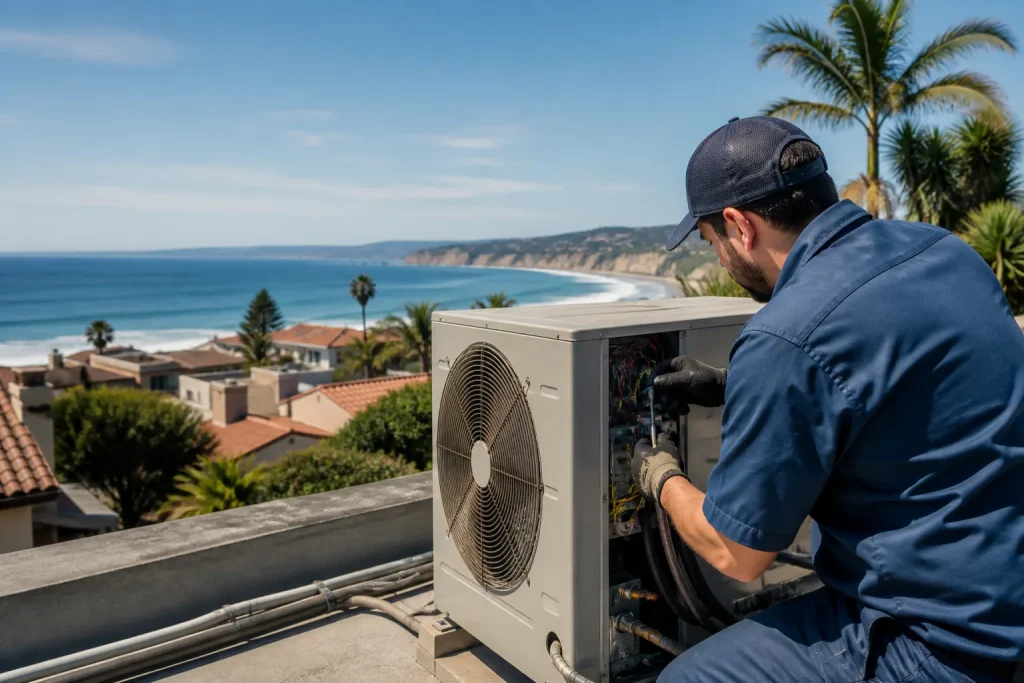
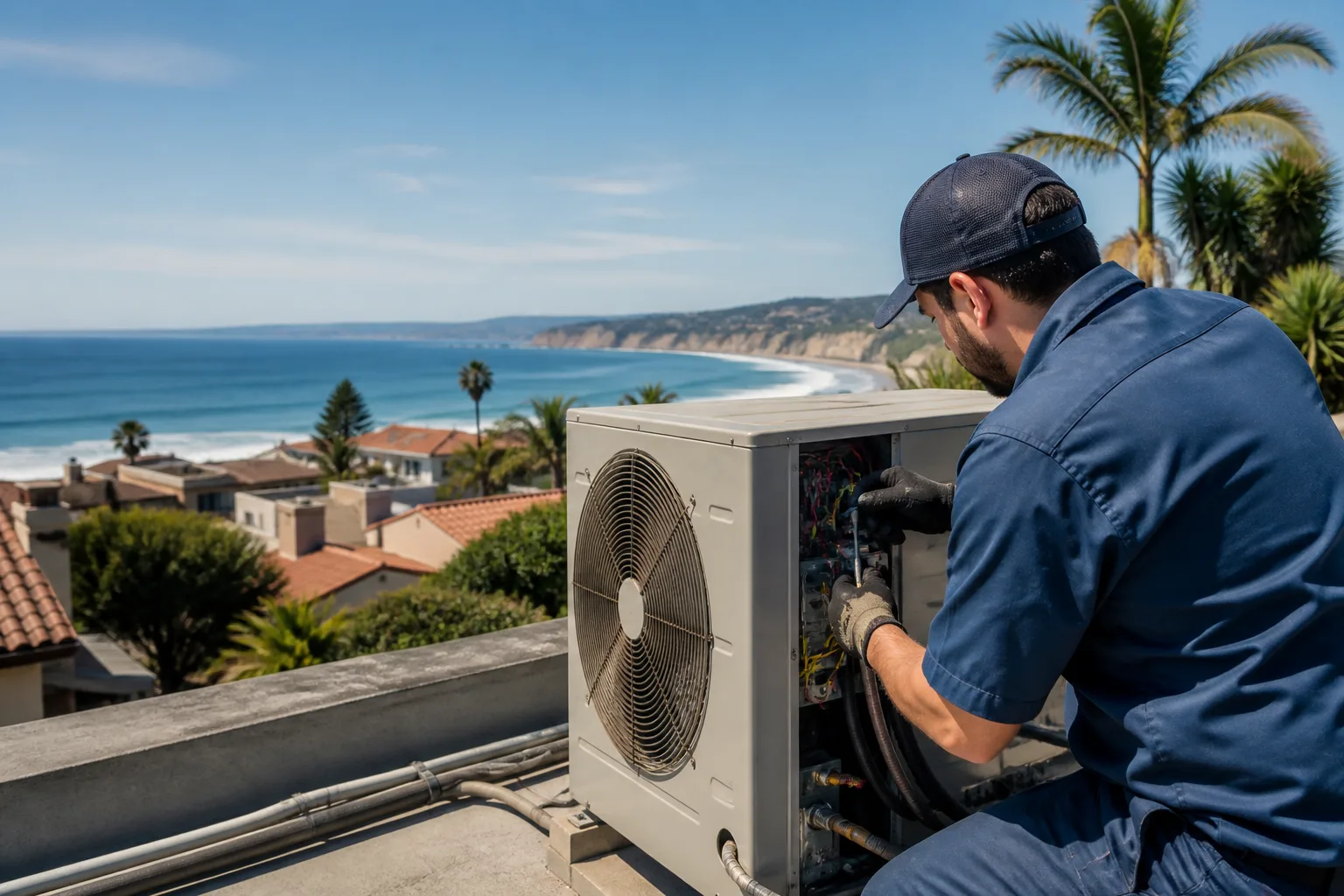
AC Repair & Installation: Repair or Replace? How San Diego Homeowners Decide
Most San Diego homeowners should repair their AC if the fix costs under $2,500 and the unit is under 15 years old, but replace it if it still runs on R-22 refrigerant or needs a compressor replacement. The mild coastal climate here means your system accumulates far fewer runtime hours than national averages suggest, so calendar age alone is a poor guide. If you’d rather not sort through the variables yourself, call us at (844) 875-9451 for a free, no-pressure assessment.
Here’s the mistake we see constantly: a homeowner in Clairemont or Mira Mesa reads online that a 12-year-old air conditioner is “at end of life” and drops $7,000 on a replacement they didn’t need. That advice was written for Atlanta or Dallas, where AC runs 1,500+ hours annually. In San Diego, most residential systems log closer to 400–600 cooling hours per year. Your 12-year-old unit here might have the same wear as a 6-year-old unit in Phoenix. The repair-or-replace math changes completely once you account for actual runtime, not just the date on the nameplate.
Why San Diego’s Climate Changes the Entire Equation
The famous “5,000 rule” — multiply repair cost by system age, replace if over $5,000 — was calibrated for climates with brutal summers. A $400 capacitor replacement on a 14-year-old system scores 5,600 and triggers replacement advice. But that 14-year-old San Diego system might only have 6,000–8,000 total runtime hours. The same hardware in Houston would have 18,000+ hours and genuinely be worn out.
We pulled a compressor out of a garage over in Pacific Beach last month where the homeowner was ready to replace a 16-year-old Bryant because “that’s what the internet said.” The unit had 4,200 documented runtime hours. We replaced the contactor and capacitor for $380. It’s running fine now. That system had years left because San Diego’s marine layer and mild summers simply don’t punish equipment the way inland desert or humid subtropical climates do.
What this means practically: we generally add 3–5 years to standard replacement timelines for coastal San Diego properties. Inland neighborhoods like El Cajon or Santee run hotter and accumulate more hours, but even there, you’re still well below national stress levels. Runtime hours matter more than birthday candles.
When Repair Is the Smarter Call
Certain failures are isolated events that don’t predict future breakdowns. In our experience across nine major brands — Carrier, Trane, Lennox, Goodman, Rheem, York, Daikin, Bryant, and American Standard — these repairs often make clear financial sense:
- Capacitor or contactor failure: $180–$340. These are wear items, not systemic problems. A new capacitor doesn’t mean your compressor is next.
- Condensate drain clog or pan issue: $150–$400. Pure maintenance failure, not equipment degradation.
- Refrigerant leak in accessible coil: $400–$900 if we can patch or seal. Only replace the coil if it’s degraded throughout.
- Fan motor replacement: $450–$750. The motor works hard; replacement is routine and extends system life significantly.
- Electrical or control board issues: $300–$800. Often a single component failure with no bearing on compressor health.
We’ve repaired 11-year-old American Standard systems in La Jolla and 13-year-old Daikin units in North Park that went on to run another 4–5 years without major issues. The key is honest assessment of whether the failure is a symptom or an incident. Gregory Hahn founded this company and still leads every technical decision, which means our diagnostics aim for the right fix, not the convenient upsell.
When to call a pro: If your system is blowing warm air, cycling erratically, or making unusual noises, don’t guess. A proper refrigerant pressure test and electrical draw measurement tells the real story in about 30 minutes. Call (844) 875-9451 and we’ll sort it out.
When Replacement Becomes Inevitable
Some failures don’t negotiate. These are the scenarios where we recommend replacement even in San Diego’s forgiving climate:
- Compressor failure: $2,000–$3,500 for replacement, and it’s the heart of the system. At 12+ years, this is often the tipping point.
- Evaporator coil degradation with R-22 refrigerant: R-22 is banned from production and prohibitively expensive. A coil replacement plus refrigerant conversion often approaches new-system pricing.
- Heat exchanger crack (furnace-integrated systems): Safety issue. No repair option exists.
- Multiple major component failures within 2–3 years: Cascading breakdowns signal systemic wear.
- Any R-22 system needing major repair: Refrigerant alone can run $100+ per pound, and supplies are dwindling. This is the one factor that overrides San Diego’s runtime-hour advantage.
The R-22 transition is the most urgent replacement trigger in San Diego right now. If your system was installed before 2010, it likely uses this phased-out refrigerant. We’ve had homeowners in Encinitas spend $1,800 on a “repair” that became worthless when the refrigerant leak returned six months later. We won’t do that to you. We’ll check the nameplate first and tell you honestly if the refrigerant situation makes replacement the only rational path.
Running the Real Numbers: San Diego Cost of Ownership
Let’s compare two realistic scenarios with SDG&E rates factored in. These are actual ranges we quote for AC repair and installation in San Diego:
| Scenario | Repair Path | Replace Path |
|---|---|---|
| 10-year-old system, capacitor failure | $280 repair, likely 5+ years remaining | $6,500–$9,500 new system, marginal efficiency gain |
| 14-year-old system, compressor failure | $2,800 compressor, 3–5 uncertain years | $6,500–$9,500, full warranty, 15+ year life |
| 12-year-old R-22 system, coil leak | $1,600+ coil + refrigerant, likely repeat failure | $6,500–$9,500, modern R-410A or R-32 system |
| 8-year-old system, fan motor | $580 repair, clear 7+ years ahead | Not recommended |
SDG&E’s tiered pricing means efficiency improvements pay back faster for heavy users, but most San Diego residential customers don’t hit the punitive tiers with 400–600 cooling hours. A 16 SEER replacement might save $180–$280 annually versus an older 10 SEER unit. That’s real money, but the payback period stretches to 10–15 years at our modest usage levels. Don’t let a national efficiency calculator drive your decision. Run the numbers for San Diego’s actual climate.
Related services in San Diego: If you’re also evaluating heating options, see our guide to heating and furnace service in San Diego, or explore whether a heat pump or mini-split system makes sense for your property.
A Practical Decision Framework
After 13 years and 428+ reviews averaging 4.6 stars, here’s the framework Gregory Hahn uses on every diagnostic call:
- Identify the refrigerant. R-22? Lean strongly toward replacement regardless of other factors.
- Identify the failed component. Capacitor, contactor, fan motor, or drain issue? Repair is usually correct. Compressor or heat exchanger? Replacement becomes likely.
- Estimate runtime hours, not just age. Coastal San Diego? Add 3–5 years to standard timelines. Inland or second-story with poor insulation? Use standard timelines.
- Check repair history. Two major repairs in three years suggests systemic decline. One isolated failure after years of reliability? Probably an incident.
- Factor your timeline. Selling in 2–3 years? Repair might carry you through. Staying for 10? Replacement’s longer warranty and efficiency may pencil out.
We diagnose right the first time because Gregory holds a Master Technician designation and personally trains our team on all nine brands we service. From a single mini-split to a full commercial system, the process is the same: measure, test, report honestly, recommend without pressure.
The Bottom Line
San Diego’s mild climate is a genuine asset for your AC equipment. Don’t let national replacement timelines push you into premature spending. Repair isolated component failures on systems under 15 years old, especially if they’re running modern refrigerant. Replace when you see compressor failure, R-22 refrigerant, or cascading breakdowns that signal systemic wear. And always factor actual runtime hours — the real measure of equipment life — rather than calendar age alone.
If you’re in San Diego and staring at a warm house and a repair quote you don’t trust, Redwood Heating & Air San Diego offers free estimates with no pressure to buy. We’ll check your refrigerant type, test your compressor amp draw, and give you a straight answer on whether repair or replacement makes sense for your specific system and situation. Call (844) 875-9451 or book online — we’ll get you sorted.
Frequently Asked Questions
Most common AC repairs in San Diego run $180–$900, while full replacement typically costs $6,500–$9,500 installed. That gap means repair pays off unless you’re facing compressor failure or R-22 refrigerant issues. Call (844) 875-9451 for an exact quote on your system — estimates are free.
No, it’s calibrated for high-usage climates. San Diego’s 400–600 annual cooling hours mean equipment ages more slowly than the rule assumes. We typically add 3–5 years to replacement timelines for coastal properties. Runtime hours matter more than calendar age here.
Not automatically. A 10-year-old system in San Diego might have only 5,000–7,000 runtime hours — equivalent to a 5–6-year-old system in Phoenix. Replace if it uses R-22 refrigerant, needs compressor work, or has required multiple major repairs. Otherwise, targeted repairs often make financial sense.
For most San Diego homeowners, no. With 400–600 cooling hours annually, even a 6 SEER efficiency improvement typically saves $180–$280 per year. At replacement costs of $6,500–$9,500, payback stretches past a decade. The better justification is avoiding repeat repair costs or escaping R-22 refrigerant pricing.
Written by Gregory Hahn, Founder & Master Technician at Redwood Heating & Air San Diego, serving San Diego since 2013.
Need HVAC Help?
Call Redwood Heating & Air San Diego — licensed & insured, available 24/7 in San Diego.
(844) 875-9451