
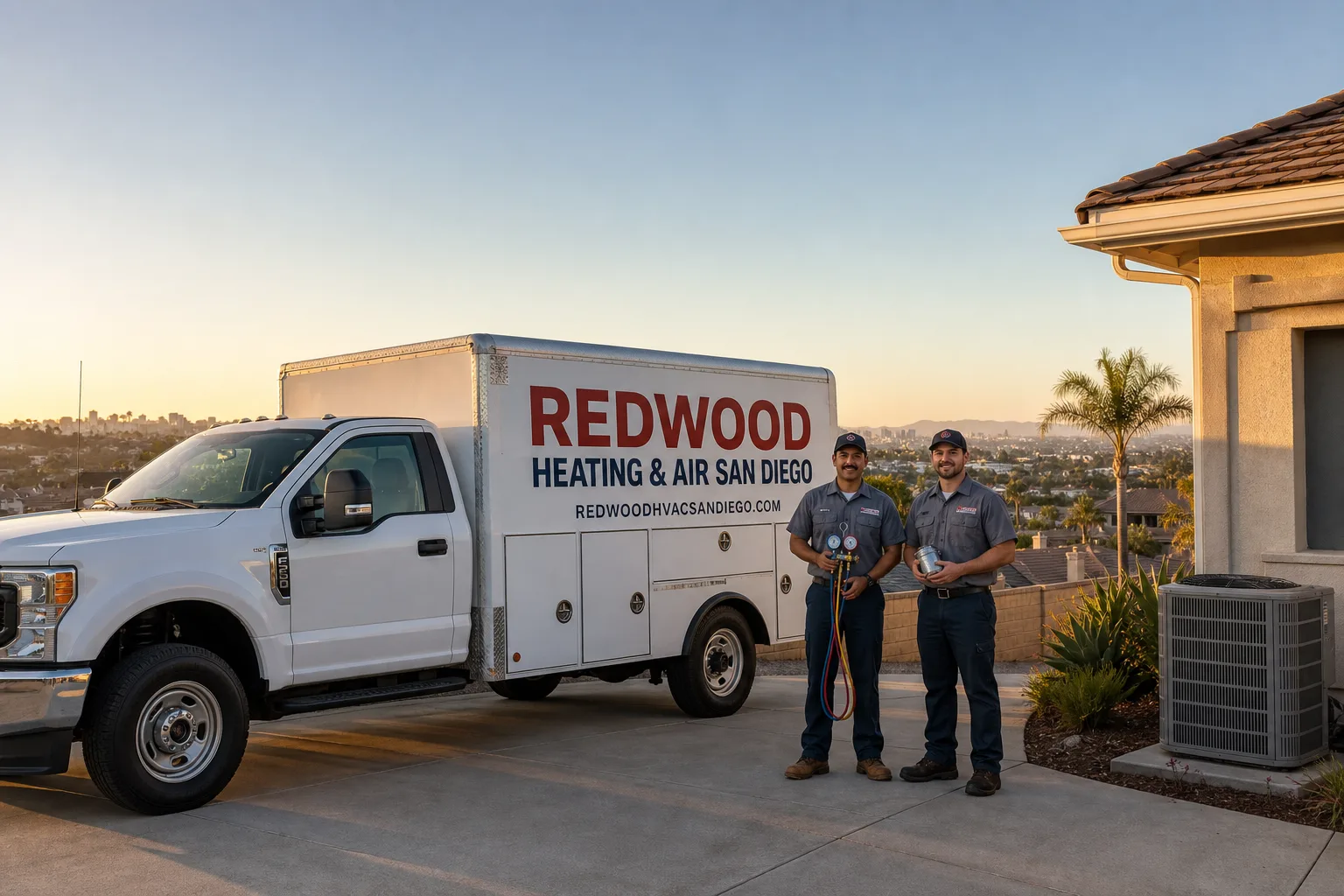
Fast, Reliable Emergency & Commercial HVAC Across Topanga
When your propane furnace quits at midnight on Old Topanga Canyon Road or your commercial rooftop unit fails before a busy weekend, you need a technician who understands this canyon’s unique systems, not a dispatcher sending a standard gas-furnace tech. We’re Redwood Heating & Air, and we’ve been responding to emergency and commercial HVAC calls in Topanga’s 90290 ZIP for 13 years. Our trucks carry propane conversion kits, LP-rated orifices, and calibrated manometers as standard equipment because SoCalGas distribution doesn’t reach most of Topanga Canyon, and arriving unprepared wastes time you don’t have. Call us at (844) 875-9451 for same-day emergency service.
Why Redwood Heating & Air San Diego Is Topanga’s Preferred Emergency & Commercial HVAC Company
Gregory Hahn founded this company and still leads every technical decision. That matters in Topanga, where a routine service call can turn into a fire-code compliance inspection and a propane pressure diagnosis in the same visit. Our Emergency & Commercial HVAC team doesn’t dispatch interchangeable crews trained on a single product line. We send master-technician-level diagnosticians who’ve worked across Carrier, Trane, Lennox, Bryant, and American Standard equipment in canyon conditions.
Our reputation here is built on specifics: 428 verified customer reviews averaging 4.6 stars over 13 continuous years. Topanga property managers call us back because we diagnosed right the first time on a buried propane system, not because we promised vague “quality.” We know the difference between a canyon floor marine-layer cool-down and a ridgeline Santa Ana bake. That local fluency means faster fixes and fewer return trips.
Our Emergency & Commercial HVAC Services in Topanga
24/7 Emergency HVAC
Topanga’s canyon geography isolates properties, and a midnight no-heat call in January isn’t a minor inconvenience, it’s a genuine safety issue when temperatures drop and you have no municipal gas backup. We responded to a midnight no-heat call on Old Topanga Canyon Road where the homeowner’s propane furnace had failed due to a clogged orifice from debris in a buried tank. We swapped in an LP-rated orifice and verified the pressure regulator, then inspected the ember-resistant vent to ensure fire code compliance before leaving. Our emergency trucks roll with propane-specific parts because standard natural-gas components won’t work here.

Commercial HVAC
Topanga’s commercial properties, from the small retail clusters along Topanga Canyon Boulevard to the studio and gallery spaces tucked into hillside lots, face a dual burden: California’s Title 24 energy codes and the Very High Fire Hazard Severity Zone’s ignition-resistant construction requirements. We size commercial systems for the canyon’s microclimate splits, where a single property can span 15–20°F temperature differences between canyon floor and ridgeline. Our commercial work includes rooftop units and split systems, always with fire-safe venting and proper propane derating where needed.

Rooftop Unit Service
Rooftop units in Topanga contend with Santa Ana winds carrying abrasive dust and elevated fire risk. Ember-resistant vent screens on newer post-Woolsey installations clog faster than standard intakes, reducing airflow and causing high-pressure trips. We clean and inspect these specialized vents during every rooftop service call, and we stock replacement ember-resistant mesh for common Bryant and Carrier commercial units. Access is often limited by steep driveways and narrow canyon roads, so our service vehicles are sized to reach hillside commercial properties that larger fleet trucks cannot.

Annual Maintenance
Annual maintenance in Topanga isn’t a checklist item, it’s survival planning for your HVAC system. We inspect propane tanks and regulators for corrosion, verify orifice sizing for altitude and fuel type, and clean ember-resistant vents before Santa Ana season. For properties with mixed-era construction, some aging 1960s cabins and some post-2018 Woolsey rebuilds, we tailor maintenance to the actual equipment and code era, not a generic template.

What happens when you call
- 1
A real person answersNo phone trees — you reach a local pro.
- 2
You get an upfront price rangeHonest numbers before anyone is dispatched.
- 3
A background-checked tech heads outLicensed & insured, dispatched right away.
- 4
You approve before work beginsNothing starts until you say go.
Trusted Brands We Service in Topanga
We service your brand. Our technicians are factory-trained or field-experienced across nine major HVAC brands: Carrier, Trane, Lennox, Goodman, Rheem, York, Daikin, Bryant, and American Standard. For Topanga customers, this multi-brand fluency means we don’t try to force a single manufacturer’s solution onto a propane-converted system that needs a specific LP-rated component. We stock common parts for Bryant and American Standard systems locally, which cuts wait times for emergency repairs in a canyon where a parts run to the San Fernando Valley can eat half a day. From a single mini-split to a full commercial system, we diagnose and repair across every major product line.
Common Emergency & Commercial HVAC Problems We See in Topanga Homes
- Propane furnace orifice clogging from buried tank debris. Topanga’s buried propane tanks accumulate moisture and particulate that standard natural-gas systems never encounter. We find clogged orifices causing intermittent flame failure, especially after tank refills disturb settled sediment.
- Ember-resistant vent screens clogged with Santa Ana dust. Newer construction required to meet post-Woolsey fire codes uses finer mesh venting that traps dust and reduces airflow. This triggers limit switch trips and short-cycles the equipment, often misdiagnosed as a failing compressor.
- Uneven cooling between canyon floor and ridgeline in A-frame cabins. Non-standard duct runs in 1960s and 1970s owner-built homes can’t balance the sharp temperature split created by Topanga’s microclimate. The compressor overworks trying to cool a hot upstairs while the downstairs runs cold.
- Builder-grade propane furnaces in post-Woolsey rebuilds failing prematurely. Installers didn’t derate for altitude and propane’s lower BTU content. The equipment runs undersized and overworked from day one, with shortened heat exchanger life.
Pricing for Emergency & Commercial HVAC in Topanga, CA
A typical emergency HVAC repair in Topanga runs $150–$650 for AC work and $150–$700 for furnace repair, depending on whether we need propane-specific parts and how accessible your equipment is in a hillside crawl space. AC installation for a standard residential system in Topanga ranges $3,500–$7,500, with complexity added by non-standard duct retrofits or fire-code venting requirements. Annual tune-ups run $80–$200.
| Service | Typical Range in Topanga |
|---|---|
| AC Repair | $150 – $650 |
| Furnace Repair | $150 – $700 |
| AC Installation | $3,500 – $7,500 |
| Tune-Up / Maintenance | $80 – $200 |
Emergency calls outside standard hours carry additional trip charges, but we quote upfront before any work begins. Free estimates for replacement or new installation. Call (844) 875-9451 for exact pricing on your specific system.
We Also Serve Cities Near Topanga
Our service radius covers the full western San Fernando Valley and adjacent canyon communities. We regularly run calls to Calabasas, Woodland Hills, West Hills, and Encino from our deployed trucks. Each of these cities presents different conditions, Calabasas has municipal gas and different fire zone classifications, Woodland Hills has denser commercial corridors, but Topanga remains our most technically demanding service area due to the propane and fire-code dual compliance burden. If you manage properties across multiple cities, one call to our Emergency & Commercial HVAC team coordinates service everywhere in our coverage zone.
Serving Topanga, CA — Our Local Coverage Area
We’re based in the Topanga area and know this community well. Use the map below to see our service coverage — if you’re nearby, we can almost certainly help.
FAQs — Emergency & Commercial HVAC in Topanga
Propane operates at higher pressure and delivers fewer BTUs per cubic foot than natural gas, so the orifice opening must be smaller to maintain proper flame characteristics and prevent dangerous over-firing. A natural-gas orifice installed on a propane system will produce a dangerously large, yellow, soot-producing flame that can damage the heat exchanger and create carbon monoxide risk. Our trucks carry LP-rated orifices sized for your specific furnace model, and we verify with a calibrated manometer before leaving. Call (844) 875-9451 if you’re unsure what fuel type your system was originally configured for.
Yes, if your property is within California’s Very High Fire Hazard Severity Zone, which encompasses all of Topanga, ember-resistant venting is required for new installations and significant retrofits under current fire code. This applies regardless of whether you’re on propane, electric, or any other fuel type, the requirement is about preventing wind-borne embers from entering your structure through HVAC penetrations. Existing systems may be grandfathered, but we inspect venting during every service call and will flag non-compliant installations that put your property at risk during Santa Ana events. We stock ember-resistant replacement vents for common Bryant and Carrier units and can upgrade most systems same-day.
Yes, and mini-splits are often the most practical solution for Topanga’s non-standard cabins and A-frames where retrofitting ductwork through steep hillside crawl spaces would be destructive and expensive. We size mini-split systems for the canyon’s microclimate splits, ensuring adequate capacity for ridgeline heat gain without oversizing the compressor. Our multi-brand expertise means we can match the right Daikin, Mitsubishi, or other mini-split system to your specific layout and electrical service, which in older Topanga cabins may need upgrading from original 60-amp panels. Call (844) 875-9451 for a free estimate on mini-split installation.
Look for a small dome-shaped cover, usually green or beige, flush with the ground near your driveway or a utility area, this marks the tank access. The pressure regulator is typically mounted on the exterior wall near where the supply line enters your home, or directly on the tank dome if it’s an above-ground installation. If you cannot locate either component, check your property survey or contact your propane supplier, but do not attempt to excavate or adjust the regulator yourself, improper pressure settings can cause furnace malfunction or dangerous gas leaks. Our technicians locate and inspect both components as standard procedure on every Topanga service call.
Call us immediately for any propane smell, complete heating failure during cold weather, burning or electrical odors from your HVAC equipment, or a cooling system that won’t run during Santa Ana heat events. In Topanga’s Very High Fire Hazard Severity Zone, any spark or abnormal operation carries elevated risk, and our emergency response includes fire-code compliance checks alongside the mechanical repair. We answer 24/7 for genuine emergencies. Call (844) 875-9451 and we’ll dispatch a technician with propane-specific equipment and parts.
Written by Gregory Hahn, Owner at Redwood Heating & Air, serving Topanga and San Diego County since 2012.