
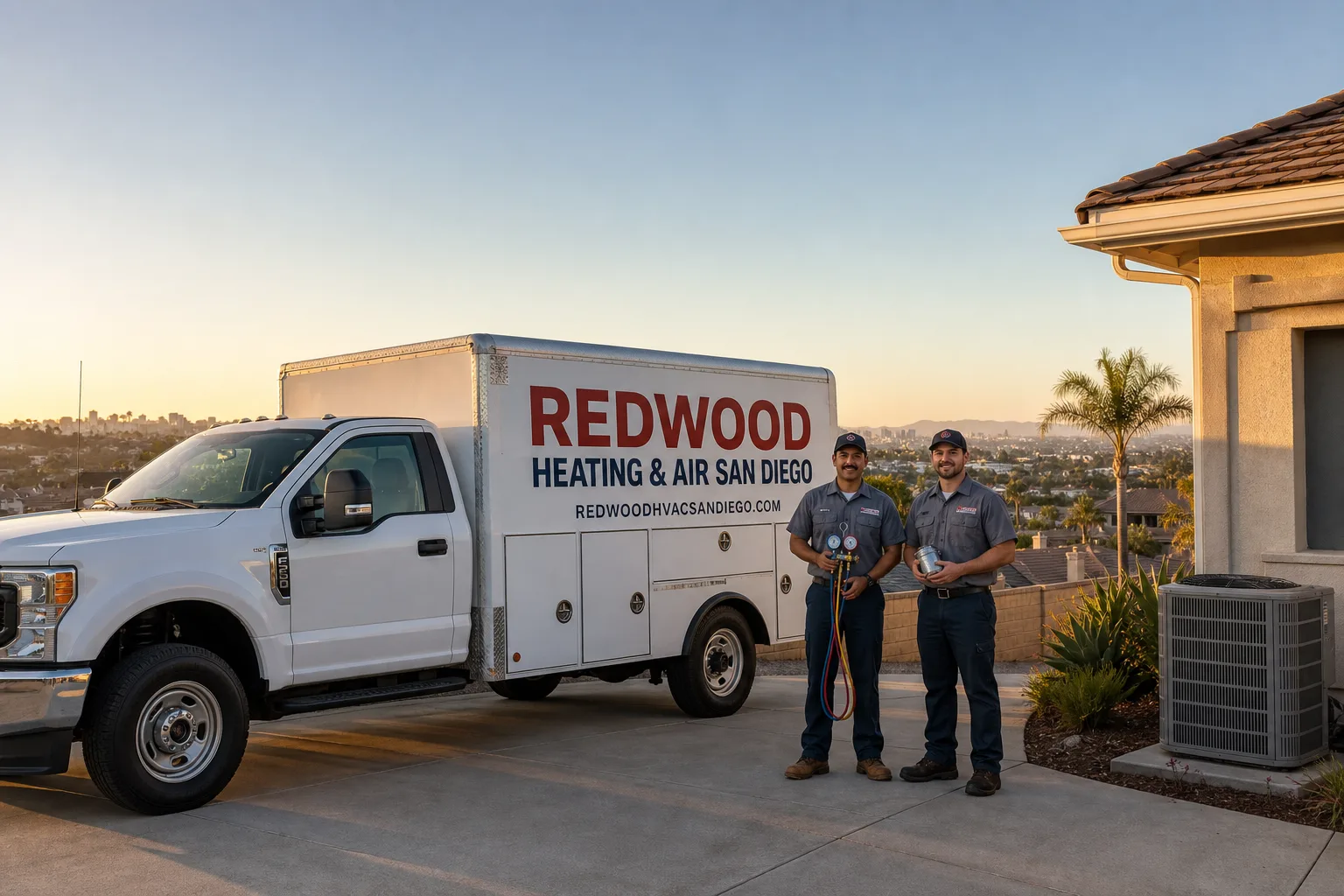
Fast, Reliable Emergency & Commercial HVAC Across Crestline
When your furnace quits during a January snowstorm on Lake Drive or your commercial rooftop unit fails at a Crestline shop along Highway 18, you need a technician who understands mountain HVAC, not another flatland dispatcher guessing at altitude problems. Redwood Heating & Air San Diego answers emergency calls throughout Crestline, and our crews make the climb from the San Bernardino Valley knowing that 4,700 feet of elevation changes everything about how gas equipment must be sized and tuned. We’re familiar with the tight crawl spaces beneath 1950s cabins, the propane delivery constraints during road closures, and the pine needle debris that chokes outdoor condensers by October. Call us at (844) 875-9451 for emergency response or to schedule a free estimate on any commercial or residential system.
Why Redwood Heating & Air San Diego Is Crestline’s Preferred Emergency & Commercial HVAC Company
Gregory Hahn founded this company and still leads every technical decision. That matters in Crestline, where a Master Technician’s eye for altitude deration can mean the difference between a furnace that runs clean for fifteen years and one that soots up in two seasons because a contractor sized it for sea-level BTU output.
Our reputation here is built on thirteen years of fieldwork and 428 verified customer reviews averaging 4.6 stars. Crestline homeowners and small commercial property managers specifically mention our ability to retrofit heating into cabins never designed for ductwork, and our willingness to explain why their propane system needs different orifice sizing than their cousin’s identical furnace in San Bernardino.
Response time to Crestline typically runs 45–90 minutes depending on Highway 18 conditions. We monitor Caltrans road status during winter weather and maintain alternate routing knowledge through local mountain roads when the main highway closes. Our Emergency & Commercial HVAC crews carry altitude-derated orifice kits and propane manifold gauges as standard equipment, not special-order items.
We know Crestline’s building stock intimately: the converted 1940s weekend cabins with no insulation and shallow crawl spaces, the small retail buildings along Crest Forest Drive, the mixed-use properties near the lake. This isn’t generic mountain-town experience. It’s specific knowledge of how Crestline’s four-season alpine climate, propane infrastructure, and vintage housing stock combine to create HVAC challenges that flatland contractors misdiagnose repeatedly.
Our Emergency & Commercial HVAC Services in Crestline
24/7 Emergency HVAC
Propane furnaces don’t wait for business hours to fail, and in Crestline, a midnight breakdown in January can become dangerous fast when temperatures drop into the teens. Our emergency line rings to Gregory Hahn’s dispatch system directly, not a call center in another state. We stock replacement boards, ignitors, and propane valves for Carrier, Goodman, and Bryant systems commonly found in Crestline cabins. During snow events, we coordinate with homeowners on access — if your driveway on Lake Drive is snowed in, we’ll talk through the safest approach or arrange to meet at a plowed location.

Commercial HVAC
Crestline’s commercial buildings are modest in scale but unforgiving in their requirements. Small retail spaces along Highway 138, restaurants near the lake, and professional offices in converted vintage structures need heating systems that can handle altitude deration without the oversized equipment that short-cycles and wastes fuel. We size commercial propane furnaces and heat pumps specifically for Crestline’s 4,700-foot elevation, calculating the roughly 18–20% BTU capacity reduction that flatland contractors routinely ignore. From a single mini-split to a full commercial system, we match equipment to actual load, not catalog ratings.

Rooftop Unit Service
Crestline has fewer true flat-roof commercial buildings than valley cities, but the ones that exist — particularly small retail strips and mixed-use structures near major road intersections — face unique problems. Rooftop units at this elevation must be altitude-derated and secured against snow load and wind exposure that San Bernardino Valley HVAC techs rarely consider. We inspect curb integrity, coil condition, and propane conversion orifice sizing on every rooftop unit service call. Pine needle infiltration into economizers and outdoor air intakes is a constant maintenance issue we address with specific filter and screen upgrades.

Chiller Service
While Crestline’s cooling load is lighter than the desert floor below, commercial properties with process cooling needs, server rooms, or specialized equipment still depend on chillers during summer afternoons that reach the mid-80s°F. We service smaller commercial chillers common to Crestline’s limited commercial base, with particular attention to altitude effects on refrigerant pressures and cooling tower performance. Our chiller diagnostics draw on Gregory Hahn’s thirteen years of multi-brand experience, including Daikin and Carrier commercial systems.

HVAC Inspection
Before you buy a converted cabin on Lake Drive or lease commercial space along Crest Forest Drive, an HVAC inspection from Redwood Heating & Air San Diego reveals what generic home inspectors miss. We check propane orifice sizing against altitude requirements, test for proper manifold pressure, evaluate whether existing equipment was derated for 4,700 feet, and assess crawl space clearance for future retrofit options. Our inspection reports include specific recommendations for right-sized propane storage to survive Highway 18 closures, not vague boilerplate about “considering fuel supply.”

Annual Maintenance
Crestline’s four-season alpine climate punishes HVAC equipment that coasts through a valley winter. Our annual maintenance program includes pre-winter propane furnace tune-ups with combustion analysis, pre-summer condenser cleaning to remove pine needle buildup, and mid-season filter changes timed to heavy pollen and dust periods. We maintain customer records specific to each property’s altitude-deration settings, so every subsequent visit builds on established baseline data rather than starting fresh.

What happens when you call
- 1
A real person answersNo phone trees — you reach a local pro.
- 2
You get an upfront price rangeHonest numbers before anyone is dispatched.
- 3
A background-checked tech heads outLicensed & insured, dispatched right away.
- 4
You approve before work beginsNothing starts until you say go.
Trusted Brands We Service in Crestline
We service your brand, whatever it is. Gregory Hahn holds factory training or equivalent field experience across nine major HVAC brands: Carrier, Trane, Lennox, Goodman, Rheem, York, Daikin, Bryant, and American Standard. For Crestline customers, this multi-brand fluency means we don’t try to shoehorn your existing propane furnace into a one-brand service protocol that ignores its actual engineering. We stock common control boards, ignitors, and pressure switches for Carrier and Bryant systems frequently found in local cabins, and we maintain supplier relationships that get Daikin mini-split components to Crestline quickly when a wall-mounted head fails in a retrofit installation. Fast turnaround matters more in the mountains, where a two-day parts delay can mean two nights without heat.
Common Emergency & Commercial HVAC Problems We See in Crestline Homes
- Propane furnaces sooting from improper altitude orifice sizing. Most San Bernardino Valley contractors install furnaces with sea-level orifice drills, then wonder why the unit cycles on and off constantly and leaves black residue. We see this repeatedly in dense cabin neighborhoods like Lake Drive, where previous owners hired the cheapest bidder from downhill.
- Outdoor condenser units choked with ponderosa pine needles. The dense canopy that makes Crestline beautiful also drops debris that packs into coil fins and fan cages. Monthly clearing is minimum maintenance; without it, head pressure spikes and compressors fail prematurely.
- Electric heat strip failures during prolonged snow events. When Highway 18 or 138 closes and propane deliveries stop, some homeowners depend on backup electric heat. These strips often fail from age or inadequate sizing because they were never intended as primary heat sources in converted vacation cabins.
- Short-cycling from oversized equipment. A furnace rated for 80,000 BTU input at sea level delivers roughly 64,000–66,000 BTU at Crestline’s elevation. Installers who don’t derate compensate by oversizing, creating equipment that heats too fast, cycles constantly, and dies young from wear.
Pricing for Emergency & Commercial HVAC in Crestline, CA
We believe in upfront pricing. Here’s what typical Emergency & Commercial HVAC work runs in Crestline’s market:
| Service | Price Range in Crestline |
|---|---|
| Furnace Repair | $150–$700 |
| AC Repair | $150–$650 |
| AC Installation | $3,500–$7,500 |
| Tune-Up | $80–$200 |
Altitude-specific work adds complexity but not hidden cost. Propane orifice changes, combustion analysis, and deration calculations are included in our standard repair and installation pricing, not line-item surprises. What does affect cost: crawl space accessibility in vintage cabins, the need for mini-split retrofit where no ductwork exists, and emergency call timing during snow events when road conditions extend labor hours. We discuss all pricing before beginning work. Call (844) 875-9451 for a free estimate with exact numbers for your property.
We Also Serve Cities Near Crestline
Redwood Heating & Air San Diego’s mountain service area extends throughout the Rim of the World communities. We regularly handle emergency calls and commercial maintenance in Lake Arrowhead, where the elevation and cabin stock mirror Crestline’s challenges; Muscoy, at the transition zone between mountain and valley climate; San Bernardino, with its larger commercial base and different altitude requirements; and Highland, where foothill conditions create their own HVAC profiles. Each community gets the same Gregory Hahn-led technical approach, adjusted for local elevation and building conditions.
Serving Crestline, CA — Our Local Coverage Area
We’re based in the Crestline area and know this community well. Use the map below to see our service coverage — if you’re nearby, we can almost certainly help.
FAQs — Emergency & Commercial HVAC in Crestline
At Crestline’s 4,700-foot elevation, gas appliances must be altitude-derated by roughly 18–20% to maintain proper combustion and avoid oversized, short-cycling equipment. San Bernardino Valley contractors working at 1,000–1,500 feet rarely encounter this requirement and often install furnaces with sea-level orifice sizing, leading to sooting, carbon monoxide risk, and premature failure. Gregory Hahn verifies deration on every propane furnace we touch in Crestline. Call (844) 875-9451 if you’re unsure whether your existing equipment was properly set up for mountain operation.
We monitor Caltrans road conditions in real time and maintain alternate routing knowledge through local mountain roads that experienced Crestline residents use during closures. Our crews carry extended fuel range and emergency supplies for longer access times, and we communicate directly with homeowners about realistic arrival windows. In extreme conditions, we may guide you through temporary safe heating measures while we coordinate access. Call (844) 875-9451 for status updates during weather events — we’ll tell you honestly if we can reach you or if local coordination makes more sense.
Propane rooftop unit failures during the first sustained cold snap, usually because summer maintenance skipped combustion analysis and orifice inspection. Small retail and restaurant spaces along Highway 138 and Crest Forest Drive depend on these units for customer comfort, and a November failure can shut down a business for days if parts must come from the valley. Our commercial emergency response includes priority parts sourcing and temporary heating solutions while we complete repairs. Call (844) 875-9451 for commercial emergency service — we understand that downtime is revenue lost.
Ductless mini-split systems are the standard solution for Crestline’s converted 1940s–1970s cabins, and we install them with altitude-specific refrigerant charge calculations and outdoor units mounted for snow-load clearance. A single outdoor compressor can serve multiple indoor heads, letting you heat the main living area and a bedroom independently without tearing into vintage walls to add ducts. Gregory Hahn has retrofitted dozens of these cabins, including a 1950s Lake Drive property where we combined a Goodman propane furnace in the crawl space with a Carrier mini-split head upstairs. Call (844) 875-9451 for a free assessment of your specific cabin layout.
Monthly from September through November, then again after every significant wind event, is the minimum for properties under dense ponderosa canopy. Pine needles pack into coil fins, reduce airflow, and cause head pressure spikes that kill compressors. We include coil cleaning and fin straightening in our annual tune-up, but the interval between professional visits requires homeowner attention in Crestline’s environment. Some Lake Drive properties need bi-weekly checks during heavy drop periods. Call (844) 875-9451 to schedule a tune-up that includes protective screen installation and maintenance coaching for your specific tree cover.
Ready to solve your Crestline HVAC problem with a Master Technician who understands mountain equipment? Call Redwood Heating & Air San Diego at (844) 875-9451 for emergency service, a free estimate, or to schedule annual maintenance before the next snow event.
Written by Gregory Hahn, Owner at Redwood Heating & Air San Diego, serving Crestline and the San Bernardino Mountains since 2011.