
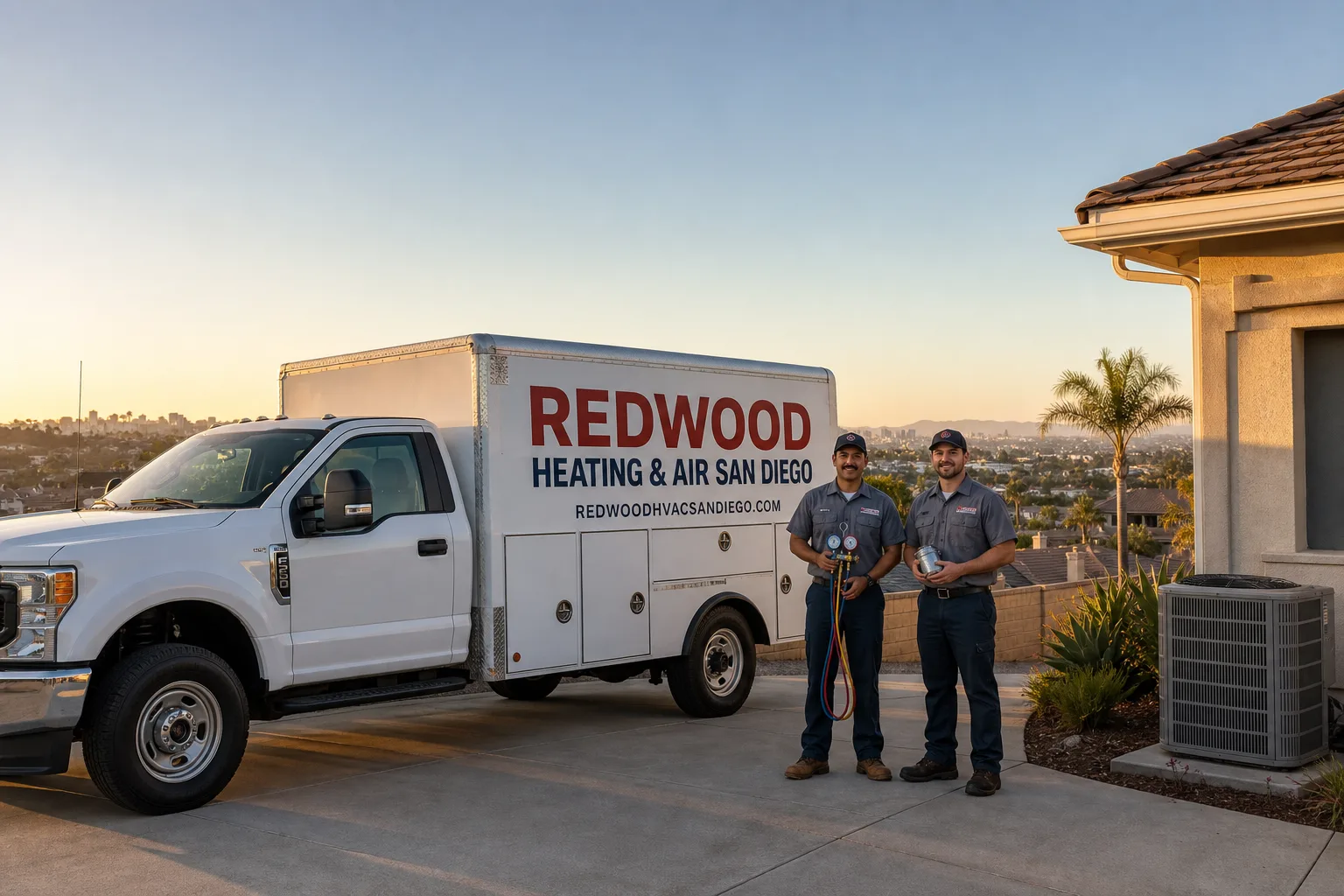
Fast, Reliable Emergency & Commercial HVAC Across Corona
Emergency HVAC repair in Corona typically runs $150–$650 for AC systems and $150–$700 for furnace work, with our Emergency & Commercial HVAC team usually responding same-day. Call (844) 875-9451 for immediate dispatch.
We’ve been driving the I-15 corridor to Corona for 13 years, and we know this city doesn’t cool down when the coast does. While Newport Beach stays in the low 80s, Corona’s pushing 105°F in July, and your commercial system doesn’t get a break. Gregory Hahn founded Redwood Heating & Air and still leads every technical decision — that means when your rooftop unit fails at midnight or your chiller quits during a Saturday dinner rush, you’re getting master-technician diagnosis, not a dispatcher reading from a script.
From the commercial strips along Magnolia Avenue in 92879 to the growing business parks near Eastvale’s border, we treat Corona as a core service area, not an afterthought. Our trucks carry parts for Trane, Lennox, Goodman, and Rheem systems because waiting two days for a coil or contactor in 105-degree heat isn’t an option.
Why Redwood Heating & Air San Diego Is Corona’s Preferred Emergency & Commercial HVAC Company
Corona business owners have left us 428 verified reviews averaging 4.6 stars, built over 13 continuous years. That volume matters because it means we’ve seen the specific failure patterns this city’s inland heat funnel produces — and we’ve fixed them.
Gregory Hahn holds a Master Technician designation, and that credential rides in every truck. You’re not getting a franchise tech trained on one brand’s troubleshooting flowchart. We service nine major HVAC brands: Carrier, Trane, Lennox, Goodman, Rheem, York, Daikin, Bryant, and American Standard. When your 2000s-era R-22 system finally gives out — and plenty are, right now, across south Corona — we can diagnose whether it’s worth saving or if replacement makes financial sense.
Response time to Corona averages under 90 minutes for emergency calls placed before 8 PM. After that, our overnight crew handles commercial properties with critical cooling needs: server rooms, medical supply storage, restaurants with walk-in refrigeration. We know which 92883 Temescal Valley commercial buildings have rooftop units accessible only by specific ladder routes, and which 92882 properties share electrical service configurations that complicate after-hours work.
Our Emergency & Commercial HVAC Services in Corona
24/7 Emergency HVAC
Corona’s position at the western mouth of the Temescal Valley funnels extreme inland heat, routinely pushing summer temperatures 15–20°F above nearby Orange County cities, forcing commercial HVAC systems to run near capacity for months. When your system fails at 11 PM on a 102-degree night, we answer. Our emergency crew carries contactors, capacitors, hard-start kits, and refrigerant for the brands we see most often in Corona’s commercial buildings. We responded to a midnight no-cool call at a commercial strip mall on Magnolia Avenue in the 92879 corridor. The rooftop unit’s contactor had welded shut due to repeated voltage sags during Santa Ana winds, and the compressor was cycling on internal overload. We replaced the contactor and capacitor, installed a hard-start kit, and performed a full emergency inspection to prevent recurrence.

Commercial HVAC
Corona’s commercial base spans retail along Ontario Avenue, light industrial near the 91/15 interchange, and professional offices in the newer developments toward Eastvale. Each building type presents different load profiles, and the 2000s construction boom left many with systems now undersized for current occupancy or degraded by years of near-continuous summer operation. We handle package units, split systems, and VAV configurations, with particular experience in the 5–25 ton range common to Corona’s strip malls and small office parks.

Rooftop Unit Service
Rooftop units in Corona take a beating. The combination of 150°F ambient rooftop temperatures and Santa Ana wind dust infiltration accelerates coil fouling and bearing wear. In 92883’s Temescal Valley corridor, south-facing low-pitch tile roofs trap radiant heat so effectively that attic temperatures routinely exceed 150°F in midsummer — and rooftop units sitting on those same roofs experience condenser pressures that test high-limit switches weekly. We clean coils, replace belts and bearings, and verify refrigerant charge against actual operating pressures, not just factory specs.

Chiller Service
While fewer Corona properties run chillers than package units, the medical and light industrial facilities that do can’t afford downtime. Our chiller work focuses on smaller reciprocating and scroll units, 20–80 ton capacity, with emphasis on leak detection and refrigerant management. Corona’s hard water and dust combination scales condenser tubes faster than coastal locations; we descale and treat accordingly.

HVAC Inspection & Annual Maintenance
Proactive inspection catches the contactor pitting and capacitor bulging that precedes summer failures. For Corona commercial properties, we schedule pre-season inspections in April and May, before the Temescal Valley heat funnel opens in earnest. Our inspection covers electrical connections, refrigerant levels, belt tension, and condensate drainage — the four systems most likely to fail under Corona’s specific stress profile.

What happens when you call
- 1
A real person answersNo phone trees — you reach a local pro.
- 2
You get an upfront price rangeHonest numbers before anyone is dispatched.
- 3
A background-checked tech heads outLicensed & insured, dispatched right away.
- 4
You approve before work beginsNothing starts until you say go.
Trusted Brands We Service in Corona
We stock common failure parts for Trane, Lennox, Goodman, and Rheem systems because these brands dominate Corona’s 2000s-era commercial installations. When your contactor welds shut on a Saturday evening, we don’t order parts Monday. Our trucks carry replacement contactors, capacitors, and control boards for the specific models we encounter most in 92879, 92880, and 92882. For less common brands — Daikin mini-splits in newer Temescal Valley builds, Bryant systems in some north Corona subdivisions — we maintain same-day supplier relationships with Riverside distributors.
Common Emergency & Commercial HVAC Problems We See in Corona Homes
- Contactor and capacitor failures from rapid humidity swings during Santa Ana wind events. These hot, desiccating offshore winds spike indoor temperatures overnight and cause rapid humidity swings that degrade capacitors and contactor contacts faster than steady summer heat alone. We see this pattern most in 92882 and 92879 commercial zones, where aging electrical infrastructure adds voltage sag to the stress.
- Attic-mounted evaporator coils freezing due to combined 150°F attic temps and sagging condensate lines. In 92883 Temescal Valley two-story structures, poorly ventilated attic cavities amplify cooling loads far beyond equipment design specs. Condensate lines soften, sag, and clog, causing water backup and coil icing that masquerades as a refrigerant problem.
- Compressor burnout in aging R-22 systems originally installed during the 2000s building boom. Corona has an unusually large cohort of original R-22 systems now hitting end-of-life simultaneously — a replacement wave neighboring cities don’t share at the same scale. South Corona’s 92883 zip sees this most acutely, with systems running at design limit for 20 years finally failing under sustained 105°F ambient loads.
- Ductwork leakage and imbalance in 1970s–1980s central Corona neighborhoods. Older 92879 and 92882 properties often retain original undersized ductwork installed before California’s Title 24 energy code requirements tightened. We measure static pressure and airflow at registers to distinguish true equipment failure from distribution problems that feel like equipment failure.
Pricing for Emergency & Commercial HVAC in Corona, CA
Honest pricing means actual numbers, not “call for a quote” deflection. Here’s what emergency and commercial HVAC work costs in Corona’s market:
| Service | Typical Range in Corona |
|---|---|
| AC Repair | $150–$650 |
| Furnace Repair | $150–$700 |
| AC Installation | $3,500–$7,500 |
| Tune-Up / Inspection | $80–$200 |
Emergency after-hours calls add $75–$150 to base repair pricing. Commercial rooftop unit work runs toward the higher end of repair ranges due to access complexity and refrigerant quantities. What pushes a job toward the top of the range? R-22 system leaks requiring full recovery and retrofit, compressor replacement on commercial package units, or ductwork modifications in inaccessible attic spaces. What keeps it lower? Caught-early capacitor or contactor replacement, straightforward belt and bearing maintenance, or coil cleaning before fouling becomes corrosion.
We provide upfront written estimates before beginning work. Estimates are free. Call (844) 875-9451.
We Also Serve Cities Near Corona
Our service radius extends naturally along the I-15 and 91 corridors to cover Home Gardens, El Cerrito Corona, Eastvale, and Norco. Eastvale’s newer commercial developments share Corona’s inland heat profile; Norco’s equestrian and light industrial properties present their own HVAC configurations. Wherever you’re located in this corridor, you’re within our Emergency & Commercial HVAC response zone.
Serving Corona, CA — Our Local Coverage Area
We’re based in the Corona area and know this community well. Use the map below to see our service coverage — if you’re nearby, we can almost certainly help.
FAQs — Emergency & Commercial HVAC in Corona
Santa Ana winds cause rapid humidity drops and voltage fluctuations that degrade electrical components faster than steady heat alone. The hot, desiccating offshore winds spike indoor temperatures overnight, forcing already-tired compressors to cycle more frequently while dust infiltration fouls condenser coils and abrasive particles accelerate bearing wear. We see contactor welding and capacitor failure rates double during Santa Ana events compared to steady summer heat. Call (844) 875-9451 for emergency inspection if your system’s cycling oddly during wind events.
Yes, we regularly respond to 92883 commercial properties including retail strips, medical offices, and professional buildings along the Temescal Valley corridor. We know the access challenges specific to this area: some rooftop units sit behind locked gates with specific key codes, and south-facing buildings with low-pitch tile roofs require particular safety protocols for after-hours work. Our average response time to 92883 is under 90 minutes for calls placed before 8 PM.
Corona’s concentrated 2000s-era construction means an unusually large cohort of original R-22 systems is hitting end-of-life simultaneously, creating a replacement wave neighboring cities don’t share at the same scale. These systems were sized for the building code of 2004, not the actual heat loads created by large poorly ventilated attic cavities in two-story tract homes. We’re replacing or retrofitting 3–5 of these systems weekly in south and north Corona during peak season. If your system is original to a 2000–2010 build, emergency failure probability is elevated.
We service and stock parts for Trane, Lennox, Goodman, and Rheem rooftop units — the four brands most common in Corona’s commercial installations — plus Carrier, York, Daikin, Bryant, and American Standard. Our trucks carry contactors, capacitors, and control boards for the specific RTU models we encounter most in 92879 and 92882 commercial zones. For less common configurations, our Riverside supplier relationships enable same-day parts retrieval.
Our emergency focus is on HVAC systems — heating, cooling, ventilation, and indoor air quality equipment. We do not service commercial refrigeration or walk-in coolers. For those systems, we recommend contacting a dedicated commercial refrigeration contractor. If you’re unsure whether your equipment falls under HVAC or refrigeration, call (844) 875-9451 and we’ll help you sort it out — no charge for the clarification.
Written by Gregory Hahn, Owner at Redwood Heating & Air, serving Corona since 2012.