
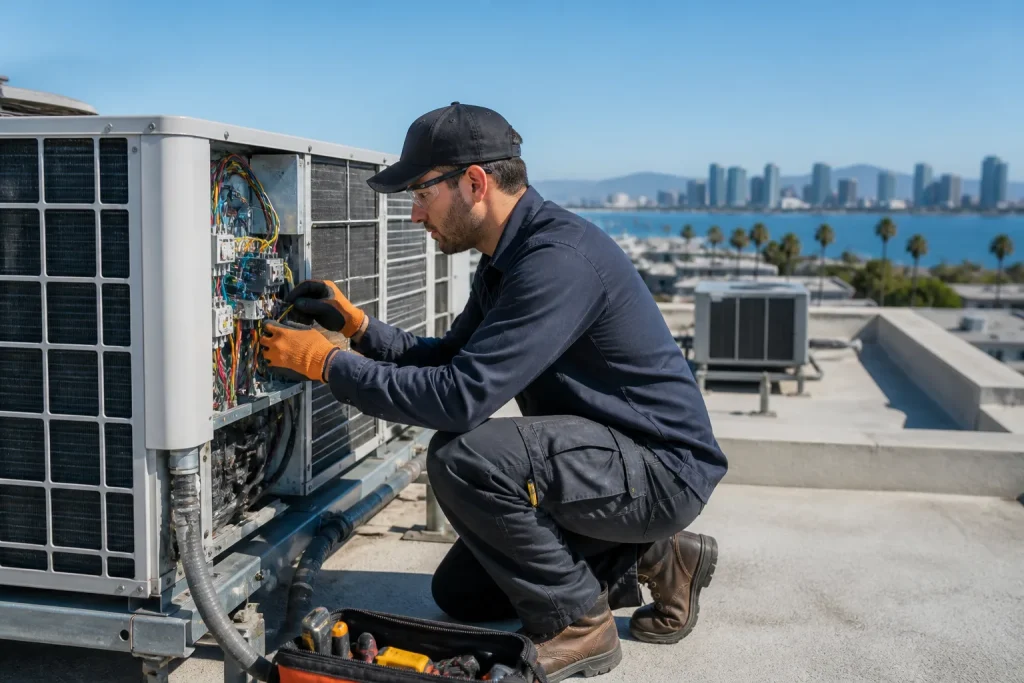
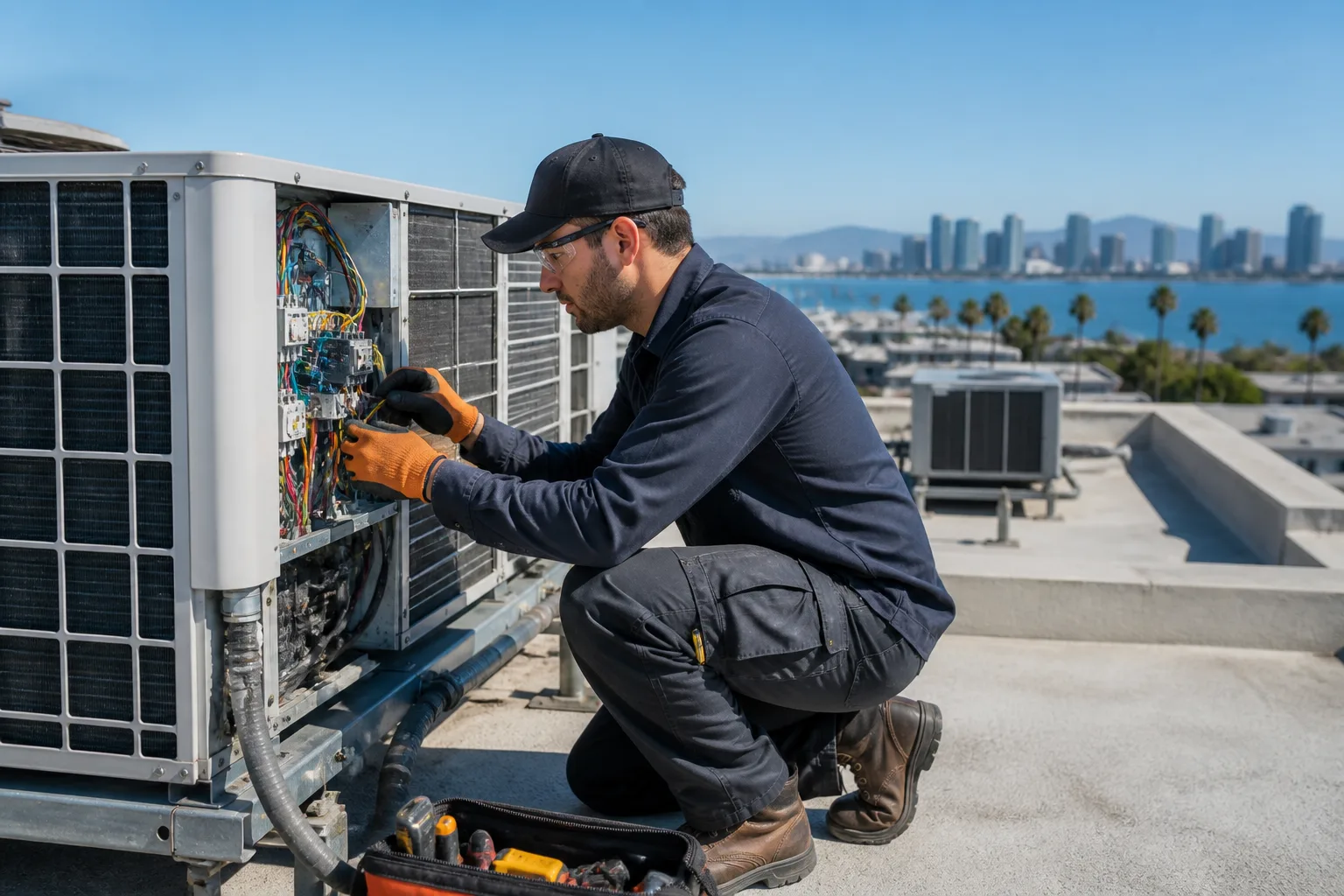
5 Mistakes to Avoid With Emergency & Commercial HVAC
Emergency commercial HVAC failures in San Diego typically cost 30–50% more to fix when the wrong service decision gets made in the first 20 minutes after discovery. The five costliest mistakes aren’t mechanical failures at all — they’re process failures that happen before any technician arrives. If you’d rather have a Master Technician diagnose your system right the first time, call (844) 875-9451.
We pulled a dead compressor out of a Kearny Mesa warehouse last month where the facilities manager had spent six hours calling three different single-brand contractors before finding someone who could even open the panel on their rooftop unit. By the time we got there, the server room was 94 degrees and they’d already authorized a $3,800 “temporary” patch on a system that needed full replacement. That 20-minute delay at the start became a $12,000 lesson.
Mistake 1: Calling a Single-Brand Contractor for Emergency Service
San Diego’s commercial buildings run a mixed fleet. You’ve got Carrier rooftops from the 2000s, Trane scroll compressors installed during the last efficiency push, Lennox units on newer strip malls, and plenty of orphaned brands that changed hands through acquisitions. When an emergency hits at 2 p.m. on a Tuesday in August, calling a dealer who only certifies on one brand is a coin flip — and you’re the one paying for the miss.
Here’s what happens in practice. The single-brand tech arrives, can’t access proprietary diagnostics on your equipment, and defaults to a parts-swap strategy. Or worse, they “find” problems that justify replacing your unit with their preferred line. We’ve seen this in Mission Valley office parks and National City industrial buildings alike. The markup on misdiagnosis runs 25–40% because you’re paying for multiple service visits, unnecessary components, and the downtime between each.
Gregory Hahn founded this company and still leads every technical decision with 13 years across nine major brands — Carrier, Trane, Lennox, Goodman, Rheem, York, Daikin, Bryant, and American Standard. We service your brand because we’ve actually worked on it, not because we have a distribution agreement to push.
What to do instead: Before an emergency, verify your service contractor’s brand certifications. Ask specifically: “What diagnostic tools do you carry for [your brand]?” If they hedge, keep looking.
Mistake 2: Failing to Document Before the Call
The most expensive sentence in commercial HVAC is “It was working fine yesterday.” Without a baseline, every emergency diagnosis starts from zero — and you’re paying hourly for the technician to reconstruct what normal looked like.
Before you call, capture:
- The exact error code or alarm state displayed on the unit controller
- Last maintenance date and what was performed
- Refrigerant type and last charge date (critical given the R-22 and R-410A phase-downs)
- Which zones lost conditioning first, and in what sequence
- Any recent construction, electrical work, or thermostat changes
We diagnosed a failed economizer in a Sorrento Valley lab last year because the facilities manager had logged a three-week drift in supply air temperature. That single data point told us the compressor was fine — the outside air damper was stuck at 100% open, dumping conditioned air into the July heat. A two-hour fix. Without that log, we’d have tested the entire refrigerant circuit first.
In San Diego’s coastal climate, salt air corrosion accelerates economizer and condenser coil failures. Documenting baseline performance catches this degradation before it becomes an emergency.
Mistake 3: Authorizing Temporary Repairs on Dead-End Equipment
This one stings because it feels like prudent cost management in the moment. Your R-22 system loses refrigerant again. The technician proposes a “top-off and seal” for $1,800 that buys you through the season. Except R-22 hasn’t been manufactured in the U.S. since 2020, reclaimed supplies are dwindling, and the price per pound has quadrupled since 2018. That temporary repair is money poured into equipment that legally cannot be recharged indefinitely.
The same trap exists for R-410A systems approaching end-of-life. While R-410A isn’t banned for existing equipment, the transition to R-32 and R-454B means replacement components are getting scarce. We’ve replaced three R-410A compressors this year in San Diego where the customer had already spent $4,000+ on “one more season” patches over two prior summers.
When to call a pro: If your commercial system uses R-22, or if it’s a 15+ year old R-410A unit with multiple refrigerant events, the honest math favors replacement. A Master Technician can run the operating cost analysis against current utility rates and show you the crossover point.
Related services in San Diego: AC Repair & Installation in San Diego | Heat Pump & Mini Split in San Diego
Mistake 4: No Written Emergency Service Agreement
The price of urgency is real, and it’s negotiable only before you’re urgent. A written emergency service agreement locks in response time commitments, after-hours rate structures, and priority dispatch sequencing. Without one, you’re a cold call on a busy afternoon — and every San Diego HVAC contractor has more demand than capacity during heat events.
Here’s the leverage you lose in real terms. A contracted commercial client in our system gets guaranteed same-day response and capped emergency rates. The non-contracted caller gets “we’ll try to get someone out today” and standard time-and-a-half billing. Over a typical summer emergency, that difference runs $800–$1,500 on the service call alone, before any parts or labor.
More importantly, the agreement forces a relationship. We know your equipment, your building’s quirks, your occupancy schedule. When that 11 p.m. alarm comes through, we’re not starting from a blank work order. That familiarity cuts diagnostic time by 30–40% in our experience.
13 years, 428+ reviews — the longevity matters because we’ve been here through multiple San Diego heat events and know which buildings struggle and why.
Mistake 5: Ignoring Utility Demand Charges During Partial Operation
This is the mistake that hides in your SDG&E bill, not your repair invoice. Commercial rate schedules include demand charges based on your peak 15-minute usage window each billing cycle. A degraded HVAC system — running constantly, cycling compressors inefficiently, or operating in bypass mode — can set a demand peak that costs more than the repair itself.
We ran the numbers for a Clairemont retail client last August. Their partially failed rooftop unit ran continuously for 11 days before they called us, trying to “get through the weekend.” The demand charge spike on that month’s bill was $2,340. The compressor replacement we eventually performed was $3,100. They spent 75% of the repair cost just keeping broken equipment online.
San Diego’s time-of-use rates make this worse. Peak hours run 4 p.m. to 9 p.m. weekdays, precisely when struggling commercial systems work hardest. Running degraded equipment during these windows is like setting money on fire with a propane torch — technically impressive, financially catastrophic.
From a single mini-split to a full commercial system, the principle holds: partial operation has a true cost that includes utility exposure, not just discomfort.
The Bottom Line
Commercial HVAC emergencies in San Diego reward preparation and punish panic. The five mistakes above share a common thread — they’re all decisions made under pressure, without the information that would have been easy to gather in advance. Document your systems, verify your contractor’s brand range, know your refrigerant status, secure a written agreement, and understand your utility exposure.
Key takeaways:
- Single-brand contractors create misdiagnosis risk and markup on mixed commercial fleets
- Baseline documentation cuts diagnostic time and cost significantly
- Temporary repairs on phased-out refrigerant systems are financial dead ends
- Emergency agreements lock in pricing and response time before urgency strikes
- Partial operation during peak rate hours can exceed repair costs in a single billing cycle
If you’re in San Diego and need help assessing your commercial HVAC emergency readiness, Redwood Heating & Air San Diego offers free estimates. Diagnosed right the first time — call (844) 875-9451.
Frequently Asked Questions
Response times range from same-day to 48+ hours depending on heat event demand and whether you have a service agreement. Contracted clients typically receive guaranteed same-day response; non-contracted emergency calls during peak periods often face next-day scheduling. Call (844) 875-9451 to discuss emergency agreement options — estimates are free.
Replacement is usually more economical when repair costs exceed 40% of replacement value, the system uses phased-out refrigerant, or energy bills have risen 25%+ from baseline. For R-22 systems in San Diego, replacement is almost always the better financial decision given refrigerant costs and availability. We can run the operating cost analysis for your specific equipment — call (844) 875-9451 for a free evaluation.
Collect the error code displayed, last maintenance date and scope, refrigerant type and charge history, which zones failed and in what order, and any recent building changes. This documentation provides the diagnostic baseline that separates a two-hour fix from a full-day investigation. If your system’s down now, gather what you can and call (844) 875-9451 — we’ll walk you through what’s most useful for your specific equipment.
Yes. Degraded cooling can trigger humidity spikes that damage electronics, inventory, and building materials; excessive runtime strains electrical infrastructure; and failed economizers or dampers can create pressure imbalances that affect ventilation and indoor air quality. In San Diego’s variable coastal climate, these secondary effects often exceed the original repair cost. If your system shows signs of failure, Heating & Furnace in San Diego or AC service should be assessed promptly — call (844) 875-9451.
Written by Gregory Hahn, Founder & Master Technician at Redwood Heating & Air San Diego, serving San Diego since 2013.
Need HVAC Help?
Call Redwood Heating & Air San Diego — licensed & insured, available 24/7 in San Diego.
(844) 875-9451