
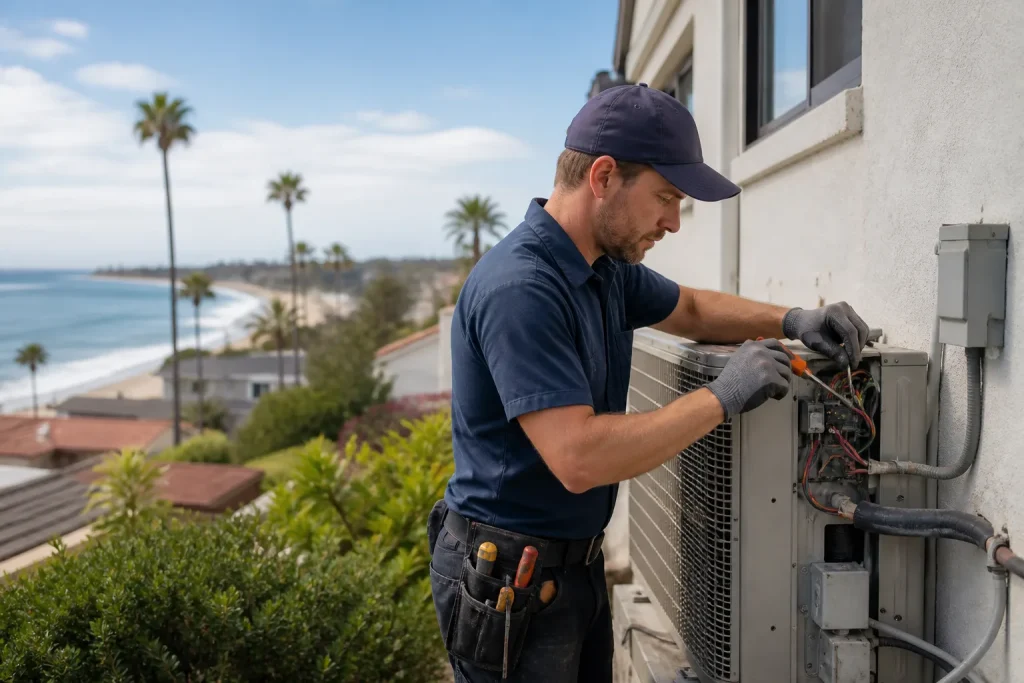
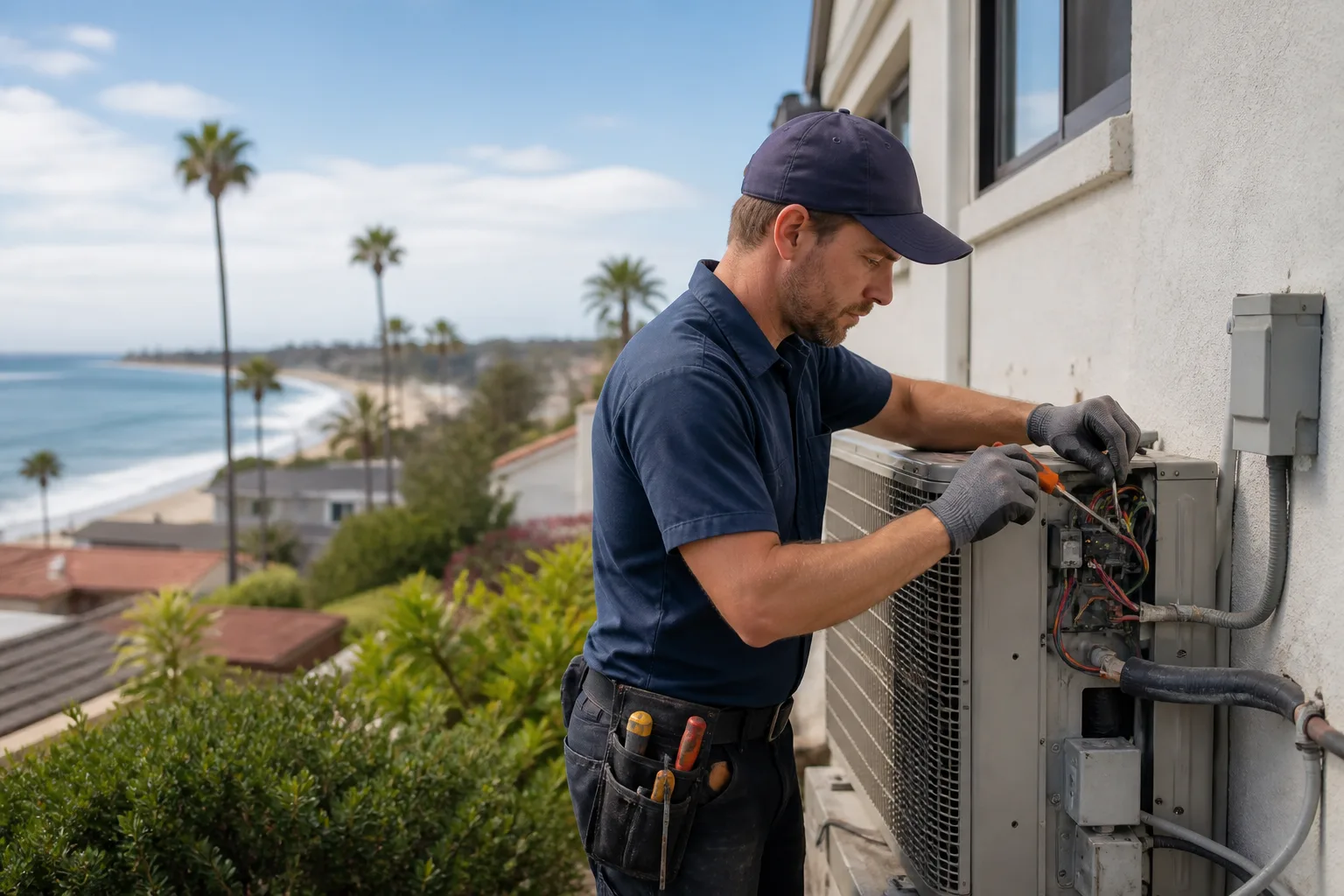
5 Mistakes to Avoid With AC Repair & Installation
The costliest AC mistakes aren’t the obvious ones. They’re the decisions that look reasonable in the moment but lack the technical context that separates a short-term fix from a lasting solution. After 13 years and thousands of calls across San Diego, we’ve seen the same five errors cost homeowners thousands in repeat repairs, shortened equipment life, and comfort they never actually achieve. If you’d rather skip the learning curve and get it diagnosed right the first time, call Redwood Heating & Air at (844) 875-9451 for a free estimate.
Mistake 1: Replacing the Failed Part Without Fixing the Root Cause
A compressor burns out. The tech swaps it. Six months later, the new compressor is dead too. In our experience, this is the single most expensive repeat repair we get called to fix after another company has been out.
Here’s what happened: the original compressor failed because a dirty condenser coil was forcing it to run at excessive head pressure, or because a stuck contactor was causing short-cycling, or because the refrigerant charge had been wrong for two years. The part was replaced. The condition that killed it was never addressed.
At Redwood Heating & Air San Diego, Gregory Hahn trains our diagnostics around what he calls “the failure chain.” When we find a blown capacitor, we check amp draw on the compressor and fan motor. When a compressor is locked, we measure superheat and subcooling to verify charge, inspect the coil fin condition, and check voltage stability at the contactor. Replacing a $40 capacitor is cheap. Missing that it failed because the condenser fan motor is drawing high amps, that’s expensive.
San Diego’s coastal humidity and inland dust create specific coil-fouling patterns. In Clairemont and Pacific Beach, we see salt corrosion on outdoor electrical components. In Poway and Santee, it’s dust loading from Santa Ana wind events. A tech who swaps the part without reading the local environment is guessing.
What to ask your technician: “What made this part fail?” If they can’t explain the failure mode, you’re paying for a repeat visit.
Mistake 2: Installing a New Unit Without a Manual J Load Calculation
Oversizing is the #1 installation error in San Diego, and it happens because contractors skip the math. A Manual J load calculation measures your home’s actual heat gain: square footage, insulation R-value, window orientation, duct leakage, air infiltration rate. It takes 60–90 minutes. Many installers skip it and size by rule of thumb: “About a ton per 500 square feet.”
An oversized AC cools the house too fast. The thermostat hits setpoint before the system has run long enough to dehumidify. You feel clammy. The system short-cycles, starting and stopping dozens of times per day. Startup is the hardest wear on a compressor. Short cycling kills it years early.
We’ve replaced 8-year-old systems in San Diego that should have lasted 15. In nearly every case, the unit was 25–40% oversized for the actual load. The homeowner paid for a bigger system, got worse comfort, and bought a replacement twice as soon.
Gregory Hahn founded this company and still leads every technical decision. That includes verifying every installation proposal against a completed Manual J. We don’t guess at tonnage. The right fix is the right size, not the convenient upsell.
Red flag: Any contractor who gives you a quote without measuring your home and asking about insulation, windows, and existing ductwork is selling equipment, not solving a problem.
Mistake 3: “Topping Off” Refrigerant Without Finding the Leak
Your AC is low on refrigerant. A tech adds a few pounds, charges you $400, and says “Call me if it happens again.” It happens again. This is the recharge-and-hope shortcut, and it’s alarmingly common.
Refrigerant doesn’t get used up. If the charge is low, there’s a leak. Period. The EPA’s Section 608 regulations require technicians to repair leaks in systems with substantial annual loss. More importantly, adding refrigerant without finding the leak is like filling a flat tire without pulling the nail.
Our leak-first discipline: nitrogen pressure test to isolate the circuit, electronic leak detection, then ultrasonic or dye verification if needed. Common leak points in San Diego systems include flare fittings on mini-split line sets (thermal cycling from our temperature swings weakens them), evaporator coil pinholes from formicary corrosion (accelerated by certain building materials), and service valve stem seals degraded by age.
We service your brand, whether it’s a Carrier Infinity with Puron, a Trane XV with its proprietary spine-fin coil, or a Daikin mini-split with R-32. Each has known leak vulnerabilities. A master-technician-level diagnosis means knowing where to look first.
What to demand: A written leak search with location identified, not just a recharge ticket.
Mistake 4: Choosing an Installer Based on Price Alone
The lowest bid on an AC installation almost never includes the details that determine whether your system performs for 15 years or fails in 8. We’ve been called to diagnose “lemon” installations where the real problem was installation shortcuts that saved the original contractor two hours and $200 in materials.
Specific failures we see:
- Refrigerant line sizing errors: Undersized liquid lines cause flashing before the expansion valve. Oversized suction lines reduce oil return to the compressor. Both void manufacturer warranties and cause premature failure.
- Improper duct sealing: San Diego’s older homes in neighborhoods like North Park and South Park often have original ductwork. A new 16 SEER condenser connected to leaky ducts performs like a 12 SEER system. You’re paying for efficiency you never receive.
- Failed or skipped permits: Unpermitted work can block home sales, void insurance claims, and leave you with no recourse if the contractor disappears. We handle permitting on every installation.
From a single mini-split to a full commercial system, our installations follow manufacturer specs for line set sizing, evacuation procedure (500 micron target, not “good enough”), and commissioning documentation. Gregory Hahn holds a Master Technician designation, and that credential is on the truck, not in a corporate office. You get owner-level accountability.
Smart comparison: Ask each bidder for their evacuation protocol, their duct leakage testing method, and whether they pull permits. The answers separate technicians from order-takers.
Mistake 5: Ignoring the Air Handler and Duct System When Replacing the Condenser
This is the mistake that looks most like smart budgeting. The outdoor condenser failed. The indoor air handler still runs. Why replace both?
Because a new condenser on a mismatched indoor coil and leaky duct system underperforms by 20–30%. We’ve measured it. The AHRI-matched rating you paid for assumes a specific indoor coil, proper airflow, and sealed ducts. Change any of those variables and your 16 SEER system delivers 11–12 SEER in the field.
Specific San Diego considerations: our mild climate means many systems run at part-load conditions most of the year. Variable-speed and two-stage equipment, which we often recommend for coastal zone homes, depends on precise airflow control from a compatible air handler. Pair a communicating outdoor unit with a single-stage indoor blower and you’ve disabled the very feature you paid extra for.
Duct leakage is equally critical. In a 1970s ranch in Mira Mesa, we measured 34% duct leakage to unconditioned attic space. The homeowner had replaced their condenser two years prior with another company. Their “new efficient system” was cooling the attic.
Related services in San Diego: if you’re considering a full system evaluation, our heating and furnace and heat pump and mini-split pages cover integrated solutions for homes where ductwork replacement isn’t practical.
When to call a pro: If your condenser has failed and your air handler is more than 10 years old, or if you’ve never had duct leakage testing, you’re making a $5,000+ decision with incomplete information. Call us for an honest assessment of what actually needs replacement.
The Bottom Line
These five mistakes share a common thread: they look like reasonable decisions without the technical depth to see the hidden cost. The homeowner who replaces a compressor twice. The family who pays for 18 SEER and gets 12 SEER performance. The property manager who recharges the same leak three times.
After 13 years, 428+ reviews, and service across nine major brands including American Standard, Lennox, and Rheem, our approach hasn’t changed. Diagnosed right the first time. Installed to manufacturer spec. Owner accountability on every job.
If you’re in San Diego and facing an AC repair or installation decision, Redwood Heating & Air San Diego offers free estimates. Call (844) 875-9451 and speak with a technician who can explain the failure chain, not just the parts list.
Frequently Asked Questions
If your system runs less than 10 minutes per cycle on a hot San Diego afternoon, or if you feel cool but clammy, it’s likely oversized. A proper Manual J calculation should be available in your installation paperwork. We provide ours with every proposal. Call (844) 875-9451 if you’d like us to evaluate your current system.
Replace if the compressor has failed and the system is over 10 years old, if repair costs exceed 40% of replacement, or if the unit uses R-22 refrigerant (phased out, increasingly expensive). Repair if it’s a single failed component under 8 years old with no history of repeat issues. We give honest assessments, not sales targets. Call (844) 875-9451 for a free evaluation.
Most residential repairs fall between $180 and $650, depending on the component. Capacitor and contactor replacements are at the lower end. Compressor or coil replacement approaches replacement territory. We provide upfront pricing before any work begins, and estimates are free. Call (844) 875-9451 for exact pricing on your specific system.
No. Refrigerant handling requires EPA Section 608 certification. More importantly, adding refrigerant without finding the leak violates federal regulations for systems with substantial loss and masks the real problem. Refrigerant is also under high pressure and can cause serious injury without proper equipment and training. This is a job for a certified technician. Call (844) 875-9451 and we’ll locate the leak properly.
Written by Gregory Hahn, Founder & Master Technician at Redwood Heating & Air San Diego, serving San Diego since 2013.
Need HVAC Help?
Call Redwood Heating & Air San Diego — licensed & insured, available 24/7 in San Diego.
(844) 875-9451