
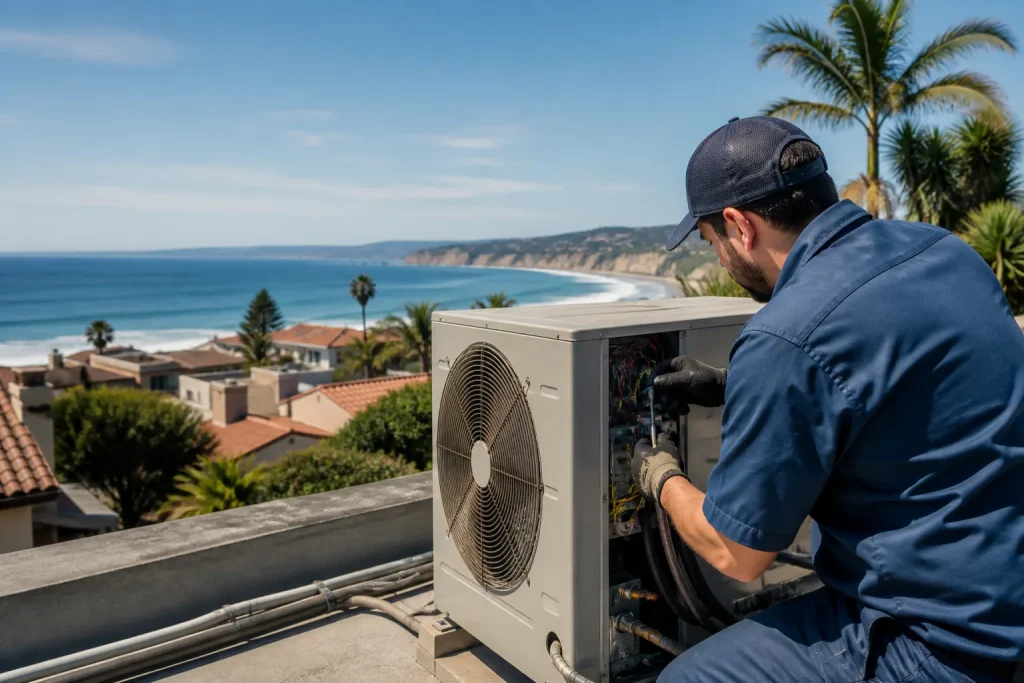
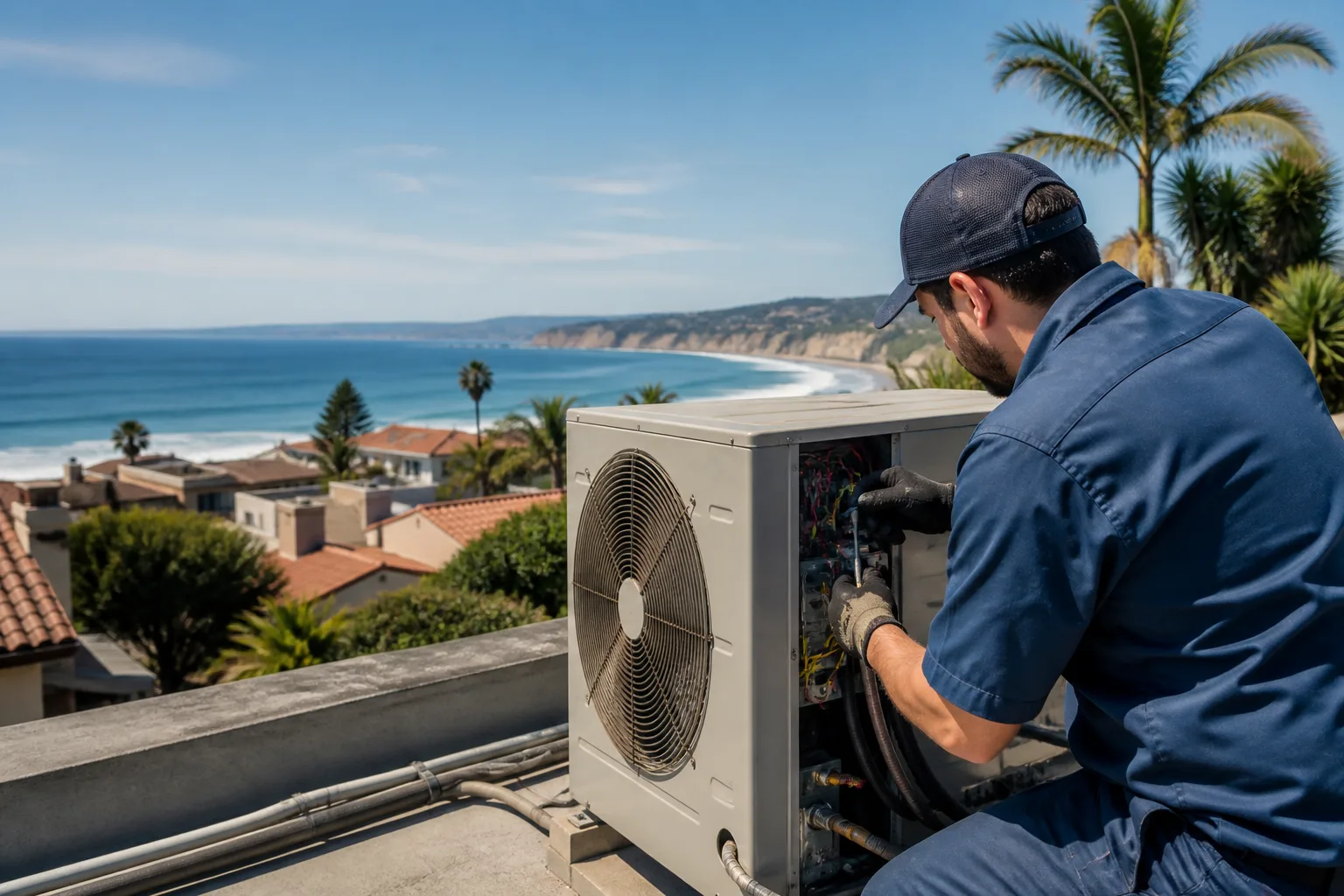
How to Choose the Right HVAC Company in San Diego
The right HVAC company in San Diego is one you can verify beyond surface credentials: a valid CSLB license with current bond and workers’ comp, hands-on experience across multiple equipment brands, and a quote that itemizes equipment separately from labor. If you’d rather skip the vetting process and talk to a team that’s already passed these checks, call Redwood Heating & Air San Diego at (844) 875-9451 for a free estimate.
A California C-20 HVAC license and 4.8 stars on Google tells you almost nothing about whether a contractor can correctly diagnose a communicating system, pull a permit without being asked, or give you an honest repair-versus-replace recommendation. We’ve been called out to homes in Clairemont and La Jolla where the previous company replaced a perfectly good control board because they didn’t know how to read fault history on a Carrier Infinity system. The homeowner paid $800 for a $200 fix they didn’t need. Here’s what actually separates competent HVAC companies from the rest in San Diego.
Verify the CSLB License Three Layers Deep
Every legitimate HVAC contractor in California needs a C-20 Warm-Air Heating, Ventilating and Air-Conditioning license from the Contractors State License Board. But the basic lookup, which most homeowners stop at, only confirms the license exists and is active. That’s not enough.
Go to www.cslb.ca.gov/OnlineServices/CheckLicenseII/ and enter the contractor’s license number. Then click through to three specific fields your competitors won’t mention:
- Bond history: Check whether the bond amount has changed or lapsed. A dropping bond can signal financial stress.
- Complaint and arbitration history: Even resolved complaints reveal patterns. Three complaints about incomplete permits in five years is a red flag.
- Workers’ compensation coverage: Click the “Workers’ Compensation” tab. If it shows “Exempt” and the company has employees, that’s illegal. If it’s expired and a technician gets hurt on your property in Rancho Bernardo, you could be liable.
We carry full workers’ comp and have never had a CSLB complaint in 13 years. Gregory Hahn founded this company and still leads every technical decision, so there’s no corporate layer between you and accountability.
Ask the Three Questions That Expose Parts-Changers
Most HVAC failures in San Diego don’t need new equipment. They need correct diagnosis. The difference between a diagnostics-first contractor and a parts-replacement contractor is about $2,000 and a lot of frustration. Ask these three questions on your initial call:
- “Will you show me the fault history before recommending a repair?” Modern furnaces and air conditioners store error codes and run-time data. A technician who won’t pull that history is guessing. We diagnose right the first time by reading what the equipment already told us.
- “Do you perform a Manual J load calculation before sizing a replacement?” If they say “we size by square footage” or “we’ll just match what you have,” hang up. San Diego’s coastal microclimates, from the marine layer in Del Mar to the inland heat of Santee, change heating and cooling loads significantly. A Manual J accounts for insulation, window orientation, and local design temperatures. Anything less is lazy and often wrong.
- “Will you pull the permit, or do I?” In San Diego, permit requirements vary by municipality. A contractor who puts permit responsibility on you is either inexperienced or avoiding scrutiny. We handle permits as standard practice.
Contractors who hesitate on any of these three questions are structurally incentivized to sell you equipment, not solve your problem.
Why Multi-Brand Experience Matters in San Diego
San Diego housing stock spans seven decades and dozens of equipment vintages. A home in North Park might have a 1998 Lennox pulse furnace. A new build in Chula Vista could run a 2023 Daikin variable-speed heat pump. A condo in downtown San Diego might have a Bryant packaged unit on the roof.
Single-brand dealers are trained to sell that brand’s new equipment. They’re not trained to repair your existing system efficiently. When you call, ask specifically: “What brands have you serviced in the field this month?” If they name one or two, or if they pivot to “we’re a certified XYZ dealer,” you’re talking to a salesperson, not a technician.
We service your brand because we’ve worked on Carrier, Trane, Lennox, Goodman, Rheem, York, Daikin, Bryant, and American Standard in actual San Diego homes and businesses. Gregory Hahn holds a Master Technician designation earned across all nine brands, not a weekend certification from one factory.
When to call a pro: If your system is short-cycling, blowing warm air in cooling mode, or making unusual noises, don’t wait for total failure. Early diagnosis prevents compressor damage and keeps repair costs manageable.
Related services in San Diego: If you’re evaluating replacement options, our AC Repair & Installation in San Diego and Heat Pump & Mini Split in San Diego pages detail how we size and install systems for local conditions.
Read the Quote Like a Quality Signal
The document a contractor hands you reveals their business model. Here’s what to look for:
- Equipment cost separated from labor cost: If these are lumped together, you can’t compare equipment value or verify markup. We itemize every quote so you see exactly what you’re paying for.
- Specific model numbers, not series names: “Trane XR14” is vague. “Trane 4TTR4036L1000A” is specific and verifiable.
- Line items for permit, disposal, and electrical: Missing line items often mean surprise charges later, or corners cut on code compliance.
- No pressure expiration date: “Good for 24 hours” is a sales tactic, not a business practice. We give you time to decide.
A vague quote signals a company that doesn’t want scrutiny. A detailed quote signals a company that’s confident in its pricing and process.
Why Founder-Led Companies Deliver What Dispatch Models Can’t
Large HVAC companies with call centers and rotating crews operate on commission structures. The technician who arrives at your San Diego home is incentivized to hit a sales target, not to fix your system efficiently. You won’t see that technician again. Accountability dissolves into a corporate phone tree.
Founder-led companies work differently. Gregory Hahn founded Redwood Heating & Air in 2013 and still leads every technical decision. When we service a home in Pacific Beach or a commercial building in Kearny Mesa, the same technical standards apply because the same person sets them. Our 428 verified reviews averaging 4.6 stars weren’t collected by a marketing team; they came from 13 years of showing up, diagnosing correctly, and standing behind the work.
From a single mini-split to a full commercial system, the technician who knows your equipment history is the same person who answers for the outcome. That’s not a feature you can add to a franchise model. It’s structural.
Key Takeaways: Your Five-Minute Vetting Checklist
- Verify CSLB license, bond, complaint history, and active workers’ comp coverage
- Ask the three diagnostic questions: fault history, Manual J, permit handling
- Confirm multi-brand field experience, not just dealer certification
- Demand itemized quotes with specific model numbers
- Prefer founder-led accountability over dispatch-model anonymity
The Bottom Line
Choosing an HVAC company in San Diego shouldn’t require becoming an expert yourself, but it does require looking one layer deeper than most homeowners bother to go. The contractors who survive that scrutiny are the ones who’ve built their business on technical competence, not marketing spend.
If you’re in San Diego and want a company that’s already passed these checks, Redwood Heating & Air San Diego offers free estimates. We’ve spent 13 years earning our reputation one repair at a time, across every major brand and every neighborhood from the coast to the inland valleys. Call (844) 875-9451 and you’ll talk to someone who can answer these questions directly, because Gregory Hahn built this company to be accountable that way.
Frequently Asked Questions
No. A C-20 license is the minimum legal requirement, not a quality guarantee. You also need to verify current bond status, complaint history, and active workers’ compensation coverage through the CSLB website. A valid license with a lapsed bond or no workers’ comp exposes you to serious financial risk. Call us at (844) 875-9451 if you want help interpreting what you find.
Ask what specific brands they’ve repaired in the past 30 days and what faults they encountered. Generic answers like “we work on everything” or immediate pivots to their dealer certification indicate limited hands-on exposure. True multi-brand fluency shows in detailed, brand-specific diagnostic language. At Redwood Heating & Air, we service Carrier, Trane, Lennox, Goodman, Rheem, York, Daikin, Bryant, and American Standard from direct field experience.
A single lump-sum number with no separation between equipment and labor. This prevents you from comparing equipment costs or identifying excessive markup. Also watch for missing permit line items, vague model descriptions like “14 SEER Trane” without a full model number, and pressure tactics like 24-hour expiration. We itemize every San Diego quote and give you time to decide.
Replace if your system is over 12 years old, uses phased-out refrigerant, or needs repairs exceeding 40% of replacement cost. Repair if it’s under 10 years old, has a clear single-point failure, and has been maintained regularly. The honest answer requires a proper diagnostic, not a sales pitch. We provide repair-versus-replace guidance based on actual system condition, not commission incentives. Call (844) 875-9451 for a free assessment.
Written by Gregory Hahn, Founder & Master Technician at Redwood Heating & Air San Diego, serving San Diego since 2013.
Need HVAC Help?
Call Redwood Heating & Air San Diego — licensed & insured, available 24/7 in San Diego.
(844) 875-9451