
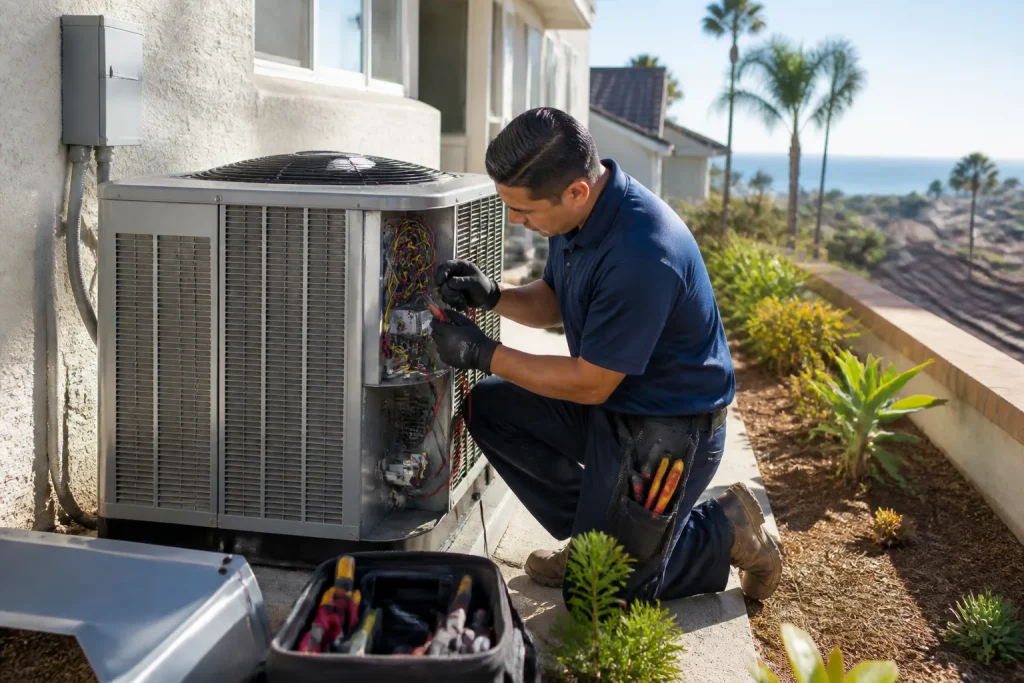
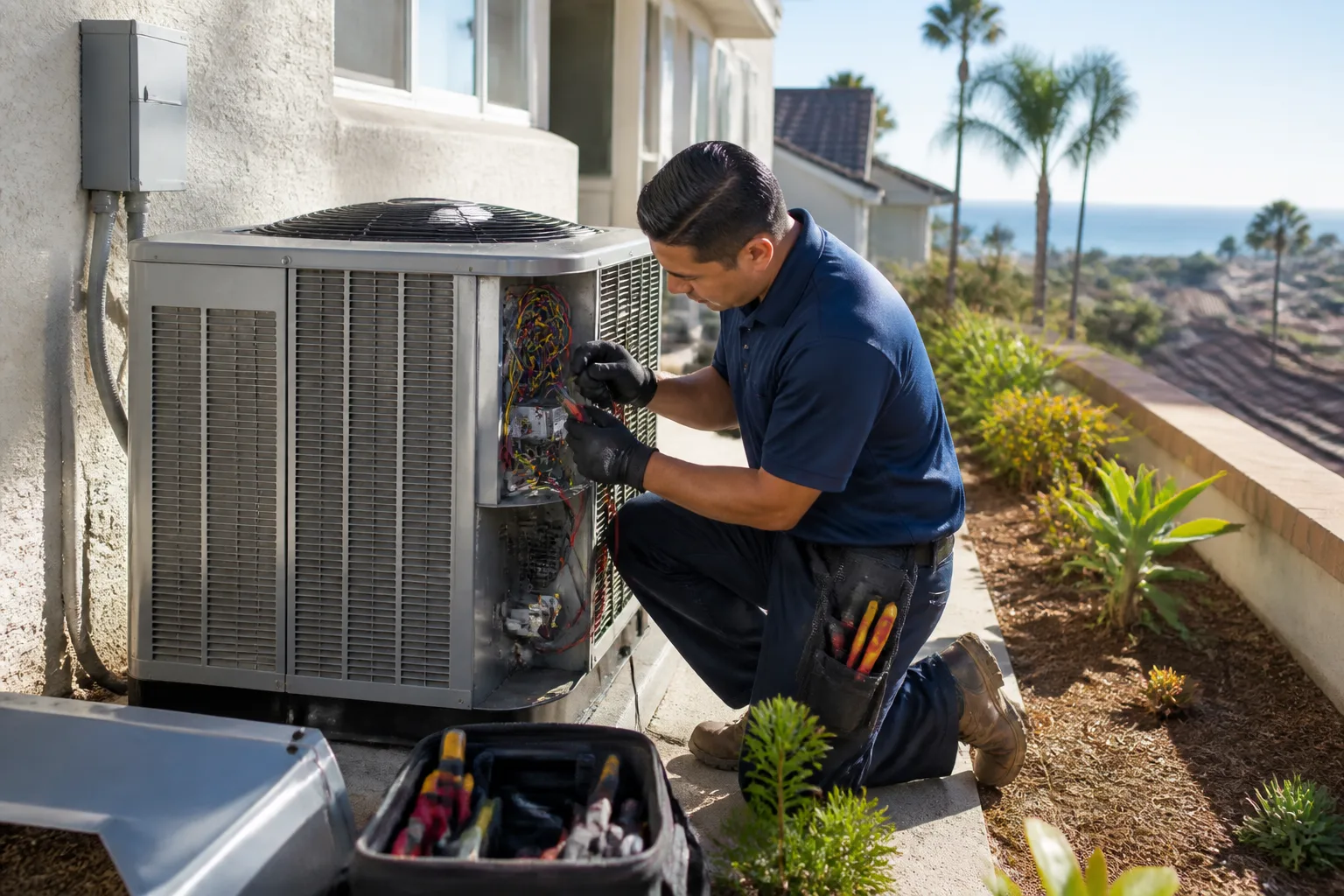
Emergency AC Repair & Installation Near Me: What San Diego Homeowners Should Do First
When your AC dies during a San Diego heat wave, shut the system off at the thermostat and breaker, check three quick fixes (breaker, thermostat battery, filter), then call for same-day service if indoor temps hit 85°F with vulnerable people at home. These first 20 minutes determine whether you’re looking at a standard repair call or an expensive emergency dispatch. If you’d rather skip the troubleshooting and get a technician out now, call Redwood Heating & Air at (844) 875-9451 — we offer free estimates and same-day emergency response across San Diego.
Here’s the uncomfortable truth: emergency AC calls in San Diego carry a 40–60% premium over standard rates. That’s legitimate cost, not gouging — after-hours labor, priority dispatch, and compressor-safe handling all cost real money. But homeowners who follow a specific sequence before calling reduce that emergency premium roughly 70% of the time, turning what feels like a crisis into a manageable next-day repair.
We’ve spent 13 years answering these calls across San Diego, from coastal La Jolla to inland Santee where the heat hits harder. Gregory Hahn founded this company and still leads every technical decision. Here’s exactly what to do in those first critical minutes.
Step 1: Shut It Down Completely to Protect the Compressor
The most expensive mistake we see is homeowners leaving a struggling system running, hoping it’ll “catch up.” Don’t. A compressor laboring against low refrigerant, frozen coils, or electrical fault can burn out in under an hour — turning a $300 repair into a $2,500+ replacement.
Turn the thermostat to OFF. Then flip the breaker labeled HVAC or AC at your electrical panel. This sounds excessive, but we’ve replaced too many compressors in Clairemont and Mira Mesa that could have been saved with this one step. The compressor is the heart of your system; it’s also the most expensive component. Protecting it buys you options.
While you’re at the panel, note whether the breaker was already tripped. A tripped breaker that resets once is often a fluke. One that trips again after reset signals a serious electrical fault — shorted compressor, failing capacitor, or wiring issue. That’s automatic professional territory. Don’t reset it a third time.
Step 2: Check the Three Non-HVAC Causes First
Before you assume your AC is broken, eliminate these three culprits. We resolve roughly 30% of “emergency” calls in San Diego with one of these fixes, no technician required.
- Tripped breaker: Check your main electrical panel. A single tripped breaker — especially after a brief power flicker — can shut down the entire outdoor unit while the indoor fan keeps running, making it seem like weak cooling rather than no cooling.
- Dead thermostat batteries: Digital thermostats with weak batteries often lose their programming or display but continue drawing enough power to look “on.” Swap in fresh AAs, even if the screen seems fine. We’ve seen $200 emergency dispatch fees avoided with a $4 battery swap in Encanto and Paradise Hills.
- Clogged return air filter: A filter choked with dust restricts airflow so severely that coils freeze, the system short-cycles, or it shuts down on safety limits. If your filter is gray and you can’t recall the last change, replace it now. Wait 2–3 hours with the system off before restarting — frozen coils need time to thaw.
If all three check out and the system still won’t start or cool, you’ve legitimately narrowed the problem to internal components. That’s when professional diagnosis becomes necessary.
Step 3: Assess Whether It’s Actually a Health Emergency
Not every AC failure demands emergency dispatch. Here’s how to decide honestly, without the panic.
True emergency — call for immediate service: Indoor temperature above 85°F with humidity over 60%, and the household includes infants under 6 months, adults over 75, pregnant individuals, or anyone with heart disease, respiratory conditions, or on diuretics. These groups dehydrate faster and can’t regulate body temperature as effectively. In San Diego’s inland valleys — El Cajon, Poway, Ramona — afternoon indoor temps can climb 15–20 degrees above coastal areas.
Urgent but not emergency — same-day or next-morning service: Indoor temp 80–85°F, healthy adults, and you can implement interim cooling. Close blinds on south- and west-facing windows, run ceiling fans counterclockwise, place bowls of ice in front of portable fans, and spend afternoon hours in the lowest floor of your home. Ground floors in San Diego’s canyon neighborhoods — think Mission Valley or University City — often stay 5–8 degrees cooler.
Standard scheduling: Evening failure when outdoor temps are dropping, or failure during mild spring weather. Don’t let a company’s urgency language pressure you into premium rates you don’t need.
Step 4: Document Everything Before the Technician Arrives
This is the step almost every homeowner skips — and it costs them. Proper documentation protects your manufacturer warranty, home warranty coverage, and your leverage if a repair goes wrong.
Take clear photos of:
- The thermostat display showing temperature setting and actual room temp
- The outdoor unit model and serial number plate
- The indoor air handler or furnace model plate
- Any visible ice on refrigerant lines or coils
- The electrical panel with the AC breaker labeled
Write down: the exact time the failure started, any unusual sounds (buzzing, clicking, grinding), whether the indoor fan still runs, and whether you’ve had previous repairs on the same component. For warranty claims, manufacturers increasingly demand this timeline. Home warranty companies in San Diego — Old Republic, American Home Shield, Choice — routinely deny claims for “pre-existing conditions” when the homeowner can’t establish when symptoms began.
We serviced a AC Repair & Installation in San Diego call in Scripps Ranch last month where the homeowner’s photos of a flashing error code on their Carrier system saved them a $189 diagnostic fee — we knew the part before we arrived.
Step 5: Vet Any Emergency HVAC Company Before Authorizing Work
Desperation makes homeowners skip due diligence. Don’t. A legitimate emergency HVAC company in San Diego should provide three things without hesitation:
- Flat-rate diagnostic fee in writing — not “our tech will tell you when he gets there.” Expect $89–$149 for standard hours, $149–$229 for after-hours emergency in San Diego. Significantly higher without justification is a red flag.
- Part pricing disclosure before installation — you should see the cost of the capacitor, contactor, or compressor before work begins. Vague “plus parts and labor” quotes invite inflated margins.
- Licensed technician confirmation — California requires C-20 Warm-Air Heating, Ventilating and Air-Conditioning contractor licensing. Ask for the license number and the technician’s name before dispatch. Any hesitation means call someone else.
Gregory Hahn holds a Master Technician designation, and that credential is on the truck, not locked in a corporate office. When you call Redwood Heating & Air, you’re getting owner-level accountability, not a franchise dispatcher sending whoever’s available.
Related services in San Diego: If your system is older and this failure has you considering replacement, our Heat Pump & Mini Split in San Diego page covers efficient alternatives to traditional AC, especially relevant for San Diego’s mild climate where heat pumps operate efficiently year-round.
What San Diego Emergency AC Pricing Should Actually Look Like
Legitimate emergency premiums follow a predictable structure. Here’s what we charge and what honest competitors typically mirror:
| Service Type | Standard Hours | After-Hours / Weekend | Holiday |
|---|---|---|---|
| Diagnostic fee | $89–$119 | $149–$189 | $189–$229 |
| Common repair (capacitor, contactor, fuse) | $180–$340 | $260–$480 | $320–$560 |
| Major repair (compressor, coil, refrigerant leak) | $800–$2,200 | $1,100–$2,900 | $1,400–$3,400 |
| Emergency installation (full system) | N/A | Base price + 25–35% | Base price + 35–50% |
Pricing significantly above these ranges — especially “diagnostic fees” over $200 or open-ended hourly rates — suggests a company exploiting your urgency. Conversely, pricing far below often means unlicensed operators or technicians who diagnose by replacement (swapping parts until something works, billing you for the experiment).
Our 428 verified reviews averaging 4.6 stars weren’t built on being cheapest. They were built on diagnosing right the first time across nine major brands — Carrier, Trane, Lennox, Bryant, American Standard, and others — so you’re not paying for our learning curve.
When to Call a Pro Immediately
Some situations bypass all troubleshooting. Call now if you smell burning plastic or electrical smoke, hear loud grinding from the outdoor unit, see refrigerant oil pooling under linesets (indicates major leak), or the breaker trips repeatedly after reset. These indicate safety hazards or catastrophic failure — continuing to operate risks fire, refrigerant exposure, or complete system destruction.
From a single mini-split to a full commercial system, we’ve handled emergency calls across every scale in San Diego. But the calls we prefer — the ones that save homeowners hundreds — are the ones where simple early steps prevented escalation.
The Bottom Line
The first 20 minutes after AC failure in San Diego determine your cost, your comfort, and your options. Shut the system down, check breaker-battery-filter, honestly assess health risk, document everything, and vet your technician. These five steps convert most emergencies into standard service calls.
Key takeaways:
- Shutting down immediately protects your compressor from catastrophic damage
- Three quick checks — breaker, thermostat battery, filter — solve 30% of “emergencies”
- 85°F indoor with vulnerable occupants is the threshold for true emergency dispatch
- Photos and timeline documentation protect warranty and home warranty claims
- Demand flat-rate diagnostics, part pricing, and license verification before any work
If you’re in San Diego and need help now, Redwood Heating & Air San Diego offers free estimates and same-day emergency response. Gregory Hahn founded this company in 2013 and still leads every technical decision. Call (844) 875-9451 — we’ll walk you through what’s urgent and what can wait.
Frequently Asked Questions
Emergency AC repair in San Diego typically runs $260–$480 for common fixes like capacitors or contactors after hours, and $1,100–$2,900 for major repairs like compressor replacement. Standard-hours diagnostics range $89–$119; after-hours diagnostics run $149–$189. Call (844) 875-9451 for an exact quote — estimates are free.
No — shut it off. Running a system that’s blowing warm air often means the compressor is still pumping with inadequate refrigerant or frozen coils, which can destroy the compressor in under an hour. Turn the thermostat and breaker off, check your filter, and call for diagnosis. The $89 diagnostic fee beats a $2,500 compressor replacement.
Replacement during an emergency costs 25–50% more than planned installation due to after-hours labor and rushed equipment procurement. If your system is over 12 years old and needs a major repair, ask your technician for both options — but know that emergency replacement rarely offers the best long-term value. For systems under 10 years, repair almost always makes financial sense. Call (844) 875-9451 and we’ll give you honest numbers for both paths.
Legitimate emergency HVAC companies in San Diego typically offer same-day dispatch within 2–4 hours during business hours, and 4–6 hours for after-hours calls. Same-day availability varies by season — July and August see highest demand. Redwood Heating & Air maintains emergency response capacity year-round; call (844) 875-9451 for current availability.
Written by Gregory Hahn, Founder & Master Technician at Redwood Heating & Air San Diego, serving San Diego since 2013.
Need HVAC Help?
Call Redwood Heating & Air San Diego — licensed & insured, available 24/7 in San Diego.
(844) 875-9451