
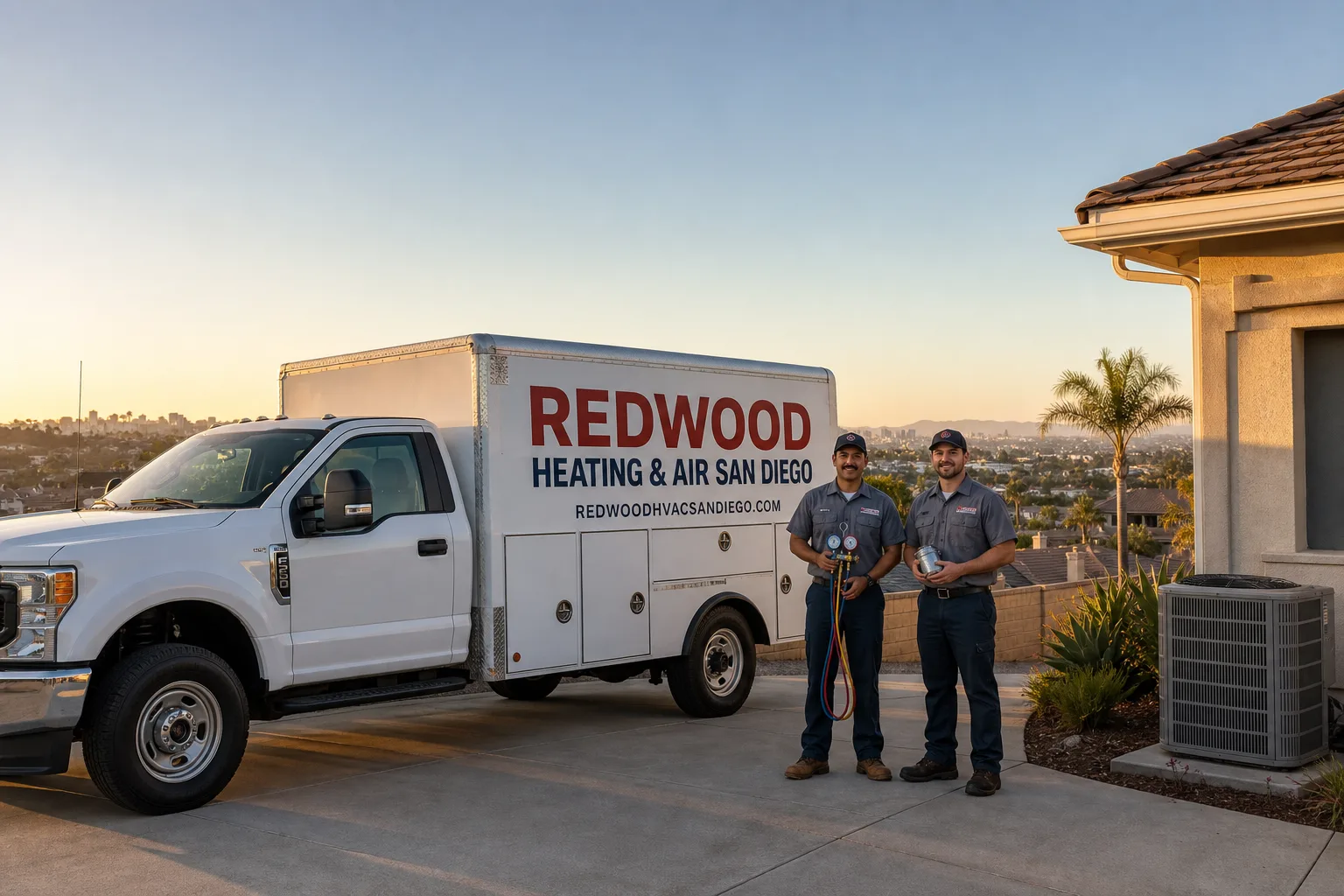
Fast, Reliable Air Quality & Ventilation Across Mill Valley
Air quality and ventilation work in Mill Valley isn’t a one-size-fits-all job. The same ZIP code, 94941, can contain two completely different indoor environments: a damp, shaded canyon floor where mold takes hold in ductwork within a season, and sun-baked hillside homes above the fog line where dry air and wildfire smoke are the bigger threats. We’ve been sorting out which problem belongs to which address for 13 years. Gregory Hahn founded this company and still leads every technical decision, so when you call Redwood Heating & Air at (844) 875-9451, you’re getting owner-level accountability, not a dispatcher reading from a script. We carry parts for Carrier, Bryant, and American Standard on our trucks, and we know which Mill Valley streets sit where on the elevation map.
Why Redwood Heating & Air San Diego Is Mill Valley’s Preferred Air Quality & Ventilation Company
Our reputation in Mill Valley was built one callback at a time, and we stopped getting callbacks when we started treating every canyon-floor job as a moisture-management project first. Thirteen years and 428 verified reviews averaging 4.6 stars tells us we’re doing something right, but the metric that matters is this: Mill Valley customers who call us tend to call us again when they move to a different house in town.
Response time matters here because the fog doesn’t wait. When a homeowner on Sycamore Avenue near Old Mill Creek smells musty air, that microbial growth is already established. We aim to get eyes on the problem fast, not next-week fast.
Gregory Hahn holds a Master Technician designation, and that credential rides in the truck with him. We service your brand, whether it’s a Daikin mini-split retrofit in a 1920s Craftsman bungalow or a full American Standard system in a hillside home off Panoramic Highway. From a single mini-split to a full commercial system, we diagnose right the first time because we’ve seen what Mill Valley’s specific conditions do to equipment.
Our Air Quality & Ventilation Services in Mill Valley
Air Filtration
Mill Valley’s air filtration needs split cleanly along elevation. Canyon-floor homes near Old Mill Creek need filters that capture mold spores and the fine organic debris that drifts down from the redwood canopy; hillside homes above the fog line face pollen, dust from dry summer conditions, and increasingly, wildfire particulate during offshore wind events. We size filter media to the actual particle load, not just the nominal MERV rating. A 4-inch pleated filter with antimicrobial treatment handles the damp-side homes better than a standard 1-inch throwaway that saturates and collapses.

UV Air Purifier Installation
UV-C lamps mounted at the coil and in the supply plenum kill active mold and bacterial growth before it circulates. In Mill Valley’s perpetually damp canyon-floor homes, we treat UV as standard equipment, not an upsell. The 1920s Craftsman bungalow on Sycamore Avenue we serviced is a textbook case: heavy microbial growth in flex duct, musty odors, allergy symptoms. Our team installed antimicrobial duct lining, a UV air purifier, and a properly sloped condensate drain line to prevent recurrence. The homeowner hasn’t called back in three seasons. That’s the goal.

ERV/HRV System Installation
Energy Recovery Ventilators and Heat Recovery Ventilators solve the ventilation puzzle that tight, efficient homes create. Mill Valley’s hillside homes above the fog line, especially the mid-century and newer builds carved into steep lots, tend to be buttoned up tight for energy efficiency. Without mechanical ventilation, CO2 builds up, VOCs linger, and the house smells stale. An ERV pre-conditions incoming air with outgoing air, so you’re not dumping heated or cooled air directly outside. For canyon-floor homes, we spec HRVs with defrost cycles that handle the near-constant high humidity without icing up.

Humidifier & Dehumidifier Installation
This is where Mill Valley’s elevation split matters most. Homes on the valley floor rarely need humidification; they’re fighting excess moisture year-round. Dehumidifiers integrated with the HVAC system or standalone units in crawl spaces keep the structure below 60% relative humidity, which is the threshold where mold stops thriving. Hillside homes above the fog line, especially those with south-facing exposure, can drop to 30% RH in summer and need humidification to protect woodwork and keep occupants comfortable. We test with calibrated hygrometers before recommending either direction.

What happens when you call
- 1
A real person answersNo phone trees — you reach a local pro.
- 2
You get an upfront price rangeHonest numbers before anyone is dispatched.
- 3
A background-checked tech heads outLicensed & insured, dispatched right away.
- 4
You approve before work beginsNothing starts until you say go.
Trusted Brands We Service in Mill Valley
We stock parts and have factory training on nine major brands: Carrier, Trane, Lennox, Goodman, Rheem, York, Daikin, Bryant, and American Standard. For Mill Valley customers, that means we’re not ordering a coil or a control board from a warehouse across the Bay and making you wait. We carry Bryant and American Standard filtration components and UV lamp assemblies on the truck, and we know Daikin’s mini-split communication protocols by heart, which matters when we’re retrofitting a redwood-clad cottage that was never designed for ductwork. Fast turnaround isn’t a slogan here; it’s having the right part when the truck pulls up.
Common Air Quality & Ventilation Problems We See in Mill Valley Homes
- Mold and biological growth in ductwork on the canyon floor. The dense redwood canopy keeps homes near Old Mill Creek perpetually damp. Flex duct in crawl spaces and attics accumulates mold faster than in drier East Bay homes. Antimicrobial duct lining and proper condensate drainage aren’t upsells; they’re standard practice if you want the fix to last.
- Salt-laden fog corrosion of outdoor HVAC hardware. Marine air drawn inland from Richardson Bay accelerates corrosion of outdoor unit coils, fastener heads, and electrical connections. We’ve seen refrigerant leaks and control board failures in 4–6 years on equipment that should last 15. Coastal-grade coatings and more frequent inspections catch this before it becomes a full replacement.
- Wildfire smoke infiltration through standard vent openings. Virtually all of Mill Valley sits in a designated Wildland Urban Interface fire zone. Standard vent covers don’t stop embers. Ember-resistant vent covers and spark arrestors on every exterior HVAC penetration are code requirements, not options, and contractors unfamiliar with the area routinely miss this.
- Inadequate ventilation in tight hillside homes. Mid-century and newer homes above the fog line are built tight for efficiency but lack mechanical ventilation. Stale air, elevated CO2, and lingering cooking odors are symptoms. ERV or HRV installation solves this without the energy penalty of opening windows.
Pricing for Air Quality & Ventilation in Mill Valley, CA
Honest numbers help you plan. Here’s what typical air quality and ventilation work runs in Mill Valley:
| Service | Typical Range in Mill Valley |
|---|---|
| Air filtration system (media upgrade) | $450–$1,200 |
| UV air purifier installation | $800–$1,800 |
| Whole-home dehumidifier | $1,500–$3,500 |
| Whole-home humidifier | $600–$1,400 |
| ERV/HRV system installation | $2,800–$5,500 |
| Antimicrobial duct lining (typical 1,800 sq ft home) | $1,800–$3,200 |
What moves the needle: accessibility of ductwork in post-and-pier foundations, whether electrical needs upgrading for UV or ERV loads, and whether we’re working around existing redwood structural members that can’t be disturbed. Hillside homes with equipment scattered across multiple levels take more labor than a single attic location. We don’t guess; we inspect and quote. Estimates are free. Call (844) 875-9451 to schedule.
We Also Serve Cities Near Mill Valley
Our service radius covers the full southern Marin County area. We regularly work in Tamalpais Valley and Tamalpais-Homestead Valley, where the same elevation and fog dynamics apply; Corte Madera, with its own marsh-adjacent moisture challenges; and Larkspur, where older hillside homes share Mill Valley’s ventilation retrofit needs. Our Air Quality & Ventilation team coordinates scheduling across all these communities, so you’re not waiting because the truck is tied up across the bridge.
Serving Mill Valley, CA — Our Local Coverage Area
We’re based in the Mill Valley area and know this community well. Use the map below to see our service coverage — if you’re nearby, we can almost certainly help.
FAQs — Air Quality & Ventilation in Mill Valley
Your home is likely on or near the canyon floor, where the redwood canopy and nightly marine fog from Richardson Bay keep humidity above 70% for months at a stretch. Ductwork in crawl spaces or unconditioned attics never fully dries, and organic debris from the canopy provides food for mold. Antimicrobial duct lining, UV treatment at the coil, and proper condensate drainage together break that cycle. Call (844) 875-9451 for an inspection; estimates are free.
Yes. Virtually all of Mill Valley falls within a Wildland Urban Interface fire zone, and ember-resistant vent covers with spark arrestors are code-required on every exterior HVAC penetration. Standard vent covers won’t pass inspection and won’t protect your home during a wind-driven fire event. We install compliant covers as part of any outdoor unit service or replacement. Not sure what you have? We check during our free estimate.
Probably not for the whole house, but possibly for specific zones. Hillside homes above the fog line are drier, sometimes too dry. The issue shifts to ventilation and filtration rather than moisture removal. Basements and crawl spaces carved into hillsides can still trap dampness, and those may need targeted dehumidification. We measure with calibrated hygrometers before recommending anything. Call (844) 875-9451 to schedule testing.
We install UV-C systems from Carrier and Bryant that mount at the coil and in the supply plenum, sized to your system’s airflow. The key isn’t the brand name alone; it’s matching lamp intensity and placement to the actual microbial load, which in Mill Valley’s damp canyon-floor homes is higher than the manufacturer default. Gregory Hahn specs each installation based on duct inspection, not catalog numbers.
Canyon-floor homes with heavy canopy debris: every 30–45 days during peak drop seasons (late summer through early winter). Hillside homes above the fog line: every 60–90 days, more frequently during wildfire smoke events. A visual check beats any calendar; hold the filter up to a light source. If you can’t see through it, airflow is already restricted. We stock standard and antimicrobial filters for Carrier, Bryant, and American Standard systems, and we can set up a recurring delivery schedule if you prefer.
Written by Gregory Hahn, Owner at Redwood Heating & Air, serving Mill Valley since 2012.